
Senior pets are not a niche. Yet a shelf labelled “Senior Pets” may not be the best way to sell to their owners. Age may explain why a product was developed, but shoppers usually arrive with a more immediate concern: a dog is slower on the stairs, scratching more often, resting differently or becoming unsettled at night.
Our view: build the senior range, but merchandize the shopping journey by need-state.
The Senior Pet Population Is Real—and Structurally Durable
The demographic case for senior pet products is strong.
52%
of U.S. dog owners had senior dogs in 2024. The share of cat owners with senior cats rose from 49% in 2018 to 54% in 2024. In other words, roughly half of dog- and cat-owning households are living with an older pet.[1]
Packaged Facts’ U.S. Pet Market Outlook, 2026–2027 identifies senior pets, subscriptions and AI-enabled pet care systems as strategic opportunities.[2]
This durable demographic warrants product depth—but population size does not tell retailers how people shop.
Shoppers Do Not Buy “Age”; They Buy Against a Need-State
When owners choose a pet wellness product, age is often context rather than the final purchase trigger.
Nextin Research’s 2026 analysis of 2,414 U.S. dog and cat owners found that the leading need-states among dog supplement adopters were joint health, skin and coat, digestion and calming. For cats, digestion led, followed by gut health, immunity, and skin and coat. Cognitive and eye health were emerging areas, running at roughly twice the market average among adopters.[3]
Packaged Facts data reported separately in 2026 reinforces the pattern: hip, joint and mobility support and probiotics were among the most popular reasons dog owners purchased supplements, while probiotics and indoor-pet formulas led for cats.[4]
The practical implication: “senior” describes the animal; “mobility” describes the shopping mission.
Need-State Mapping for a Senior Pet Assortment
| Need-state | What current evidence indicates | Retail assortment implication | Useful adjacencies |
|---|---|---|---|
| Joints and mobility | A leading driver for dog supplement purchasers | Use as an anchor need-state with sufficient choice across formats and price tiers | Orthopedic beds, ramps, steps, supportive harnesses |
| Skin and coat | A high-volume, established need-state | Treat as an accessible entry point into wellness; make product differences easy to compare | Grooming, sensitive-skin care, coat care |
| Digestion and gut health | Strong for both dogs and cats | Build clear cross-species navigation while keeping species-specific formulas distinct | Food transitions, probiotics, feeding accessories |
| Calming | An above-average, mid-stage growth area in Nextin’s analysis | Plan for situational demand without limiting the category to seasonal events | Travel, crates, enrichment, bedtime routines |
| Cognitive health | Emerging and over-indexing among current supplement adopters | Curate selectively; prioritize credible substantiation and clear education | Senior enrichment, sleep and daily-routine support |
Why a Pure Age-Based Shelf Can Become a Price Comparison
This is a retail interpretation, not a direct finding from the cited studies.
When every product is united mainly by “senior,” shoppers have limited help distinguishing intended benefits, usage occasions and evidence. Comparable packs begin to look interchangeable—and interchangeable products invite price comparison.
That can hurt formulations with differentiated ingredients or better substantiation. A need-state structure instead prompts shoppers to ask:
- Which option fits the concern I am seeing?
- What makes this formula different?
- How should it fit into my pet’s routine?
- What should I observe over time?
Those are better questions for conversion and repeat purchase.

Three Rules for Building a Better Senior Pet Range
1. Lead With the Need-State; Use Age as a Qualifier
Use mobility support, digestive wellness or calming support as primary navigation. Use “senior,” age guidance and species as secondary qualifiers on shelf strips, packaging, filters and product pages. One product can occupy two systems:
- The physical or digital category is organized around the need-state.
- The product is tagged as appropriate for senior dogs, senior cats or a defined life stage.
2. Place Products Near the Problem Context
Adjacency should reflect the moment when the concern becomes visible.
Mobility support can sit near orthopedic bedding, ramps or supportive walking products. Calming support may connect with travel, crates or evening routines. Digestive support can be introduced where shoppers consider food transitions.
Use deliberate secondary placements, bundles and signposting. In larger stores, a senior wellness hub can route shoppers to need-state zones rather than becoming a closed island of unrelated “7+” products.
3. Give Staff One Defensible Benefit Statement—and One Follow-Up Question
Every premium SKU needs one compliant, support-oriented statement a store associate can deliver accurately—not a paragraph of mechanism or a disease claim—followed by a qualifying question.
For example:
“This product is designed to support everyday mobility in older dogs. What change in your dog’s routine have you noticed?”
This moves the conversation from a generic age label to an observable need while avoiding diagnosis.
Online, Need-State Logic Becomes Even More Important
Nextin reported that 91% of dog supplement purchasers buy dog products online, while a majority also use physical stores. Packaged Facts estimated that approximately 70% of pet supplement sales take place online.[4] Retailers therefore need consistent need-state language across shelves, search, filters, content and marketplace listings.
Online shoppers may search “joint support for older dogs,” “dog calming support at night” or “senior dog digestion”—combining a concern with life stage. Do not force them to choose between symptom and age.
A stronger digital structure uses:
- Need-state landing pages as primary discovery routes
- “Senior” as a filter, product attribute and supporting keyword
- Benefit-led product titles and image copy
- Comparison content based on format, routine, evidence and intended support
- Internal links between education, monitoring products and nutrition
- Bundles or subscriptions organized around a daily routine
For SEO, one “senior pets” hub can target the broad term while deeper pages address specific, higher-intent needs.

The Missing Retail Question: “Is This Doing Anything?”
The harder part of senior wellness may be sustaining confidence after the first sale. Lillie & Lee’s 2026 survey of 4,095 members of its pet-parent community found that 65.2% gave supplements to their pets.[5] Routine use creates a new expectation: owners want to know whether anything is changing.
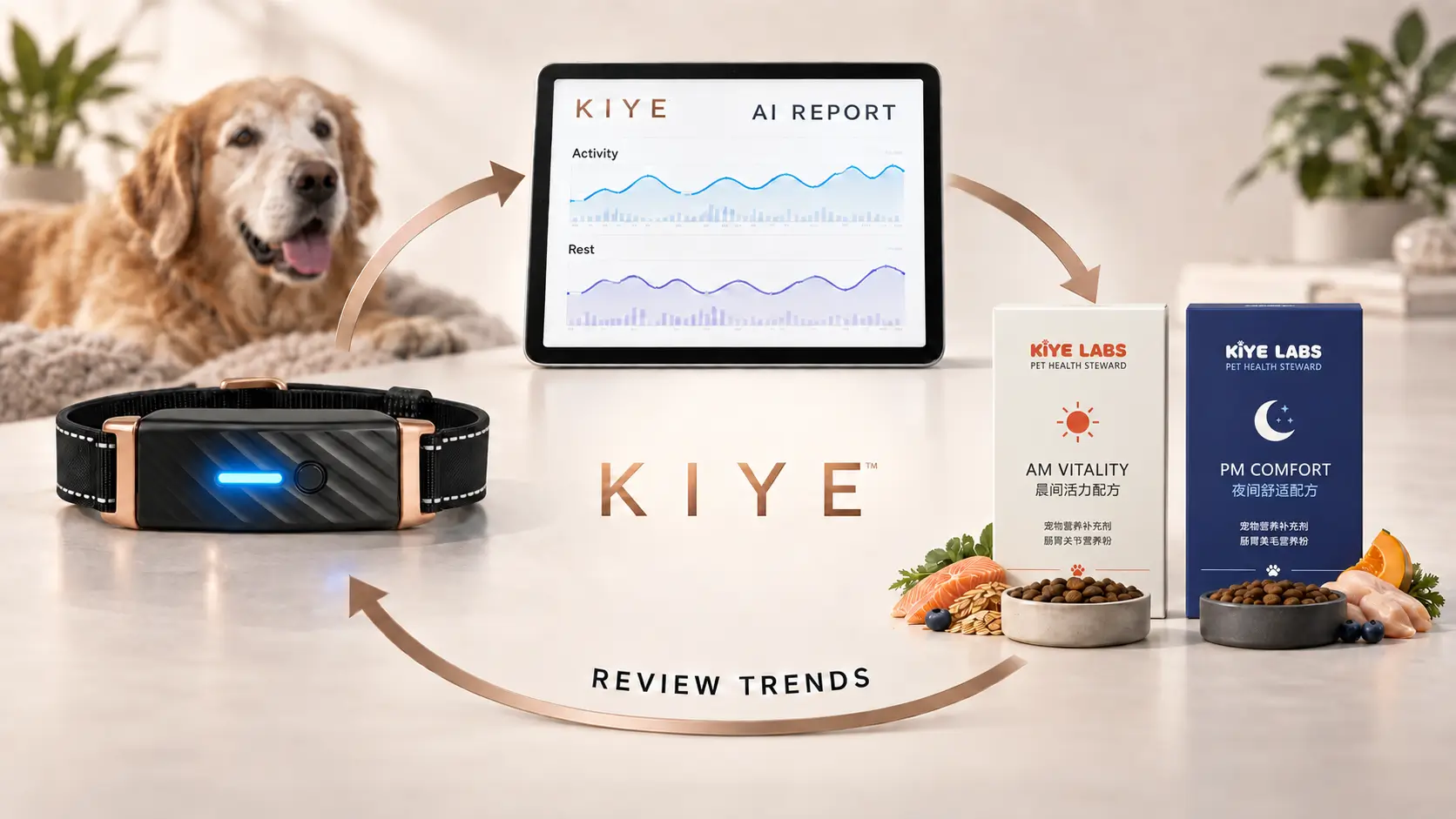
An integrated system can create more value than an isolated SKU. KIYE connects three layers:
- The KIYE Smart Health Collar supports continuous at-home monitoring of activity and rest patterns, PPG heart-rate trends and infrared body-surface temperature trends.
- KIYE’s AI intelligence organizes longitudinal data into structured wellness trends and reports, making patterns easier to review than raw readings alone.
- AM Vitality and PM Comfort senior dog nutrition create a day-and-night nutrition routine that can support subscription and repeat purchase.
This is not a promise to diagnose, treat or prevent disease. It is a way to review observable wellness trends across a nutrition routine and respond more usefully to “Is this doing anything?” For partners, that closed loop can support education, retention and differentiation.
Key Takeaways
- Roughly half of U.S. dog- and cat-owning households live with a senior pet, making older-pet wellness a durable category opportunity.
- Owners tend to shop around need-states—especially mobility, skin and coat, digestion, calming and emerging cognitive support—not age alone.
- A pure age-based shelf can make products appear interchangeable and push the decision toward price.
- Lead with need-state, create problem-context adjacencies and equip staff with one defensible benefit statement plus one qualifying question.
- Online, use symptom-led landing pages and content while retaining “senior” as a filter, qualifier and supporting search term.
- KIYE’s closed loop—smart monitoring, AI intelligence and day-and-night nutrition—helps partners move from product claims toward longitudinal wellness visibility.
FAQ
Should retailers still stock senior-labelled pet products?
Yes. Life stage matters to formulation and qualification. Use “senior” as a secondary navigation layer, not the only discovery route.
What is the highest-priority need-state for a senior dog assortment?
Joint and mobility support is a logical anchor because it is a leading purchase driver. Shelf depth should still reflect local sales and product evidence.
Should a retailer create a dedicated senior pet aisle at all?
It can work as an educational destination, especially in a large store, if it connects shoppers to need-state zones and secondary placements.
How should “senior” be used for e-commerce SEO?
Use it in category copy, filters, attributes and long-tail phrases such as “mobility support for senior dogs.” Link need-state pages to a broader senior hub.
How does KIYE help retail partners answer “Is this doing anything?”
KIYE combines longitudinal at-home wellness trends, structured AI reports and an AM/PM nutrition routine, enabling pattern review without diagnostic or treatment claims.
Build a Senior Range Around the Reason People Buy
Age belongs in formulation science. Need-state belongs at the front of the shopping journey.
Separating those roles makes the category easier to shop, protects premium differentiation and supports repeat purchase. The opportunity is not simply more “senior” SKUs; it is connecting an observed need with a credible daily-care routine and the trends that follow.
See why KIYE connects smart monitoring, AI intelligence and day-and-night nutrition, or discuss wholesale, distribution, retail and e-commerce partnerships at info@kiyepet.com.
Sources
- Petfood Industry, “US dog, cat population growth slowed 2018 to 2024; cats rose, dogs fell,” January 23, 2025, reporting Packaged Facts data.
- Packaged Facts, “U.S. Pet Market Outlook, 2026–2027,” May 2026.
- Petfood Industry, “4 pet supplement consumer segments to watch,” June 8, 2026, reporting Nextin Research presented at the 2026 NASC Annual Conference.
- Petfood Industry, “Pet supplement market poised for double-digit growth,” April 2, 2026, citing Nextin Research and Packaged Facts’ December 2025 Survey of Pet Owners.
- Lillie & Lee, “Pet Wellness Consumer Trends Report 2026,” July 28, 2026; percentages summarized by Petfood Industry, September 10, 2026.