What Does a Smart Collar Track? GPS vs Health Sensors
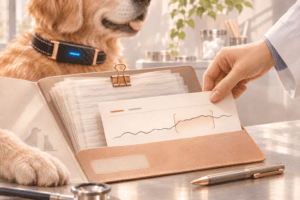
A smart collar is the most asked-about product in the pet-tech aisle right now — and the most misunderstood. Distributors and clinics we talk to almost always open with the same question: "Does it measure heart rate?" The honest answer is more useful than a yes or no, because what a collar tracks depends entirely on which sensors sit inside it. Here is a straight breakdown of what GPS, motion, and clinical-grade sensors each can — and cannot — tell you about a dog’s health.
What Can a Smart Collar Actually Track Today?
Start with a simple truth: there is no single "smart collar." There are tiers of hardware wearing the same label, and each tier reports a different kind of signal. Most shipping collars combine a location chip with a motion sensor and some form of software interpretation on top. Continuous vital signs — heart rate, respiration, temperature — are a separate, harder category that only some devices approach, and usually at rest rather than on a running dog.
The practical map looks like three layers. Knowing which layer a product sits in is the fastest way for a buyer to avoid disappointment and for a distributor to set correct expectations on the shelf.
Location: where is the dog?
This is the mature, reliable layer. GPS (often with Wi-Fi and cellular assist) answers "where is my dog right now" and draws a path or a safe zone. It is the reason most buyers first buy a collar, and it is the easiest claim to verify.
Activity & behavior: what is the dog doing?
An accelerometer plus an AI classifier turns motion into meaning — play, rest, eating, drinking, walking, sleep, and more. This layer is shippable today and is where most of the daily value actually lives for an aging pet.
Vitals: what is the body doing?
Heart rate, respiration, and temperature need clinical-grade sensors — optical (PPG) or pressure-based (PVDF). These are the hardest to do well on a moving, fur-covered animal, and for many brands they sit on the roadmap rather than in the box.

Does a GPS Collar Measure Heart Rate?
Short answer: a GPS collar, as such, measures location — not heart rate. Heart rate requires an optical sensor (PPG) pressed against the skin that shines light through tissue and reads the pulse. That is a different component, a different power budget, and a different validation burden than a GPS module. Most location-focused collars simply do not include it, and the listing that implies "health monitoring" may mean behavior tracking, not a pulse reading.
We are direct with partners about this because the gap is where trust breaks. KIYE’s Gen1 Smart Collar (dog and cat) is built and shipping with GPS positioning plus automatic recognition of a dozen-plus daily behaviors — but it does not measure heart rate. Heart rate is on the roadmap through the Collar Plus (PPG + infrared). A distributor who tells a buyer "yes, it reads the heartbeat" on a GPS-only unit is setting up a return, not a reorder.
Can a Smart Collar Monitor Breathing or Respiration?
Respiration is, if anything, a step harder than heart rate. You can infer a beat from optical pulse; you need either a derived signal from that same optical sensor or a pressure-based method (such as PVDF) to count breaths, and both work best when the animal is still. On a collar wrapped around a moving, panting dog, reliable respiration is rare. The honest place to capture rest-time breathing is usually a stationary pad, not a worn device in motion.
That is exactly why at-home rest vitals belong to a different product form. KIYE’s Smart Mattress uses a PVDF sensor pad to read rest-time heart rate and respiration at home, with no camera — and it is in development, not shipping. The point for a buyer: ask whether the "respiration" claim comes from a worn device in motion (treat with skepticism) or from a purpose-built rest sensor (more credible, often a separate SKU).

What Does "Activity" and "Behavior" Tracking Really Mean?
This is the layer buyers under-rate and the one that quietly earns the reorder. An accelerometer counts steps; an AI classifier gives those steps a name. A good system recognizes a dozen-plus daily behaviors — play, rolling, chewing, eating, drinking, toilet, walking, running, jumping, rest, sleep, and more — and turns them into trends. For a senior dog, those trends are the early-warning system: a gradual drop in activity, a change in sleep, a hesitation before a jump.
None of that is a heartbeat, and it should not be sold as one. But "my old dog is moving less and sleeping differently" is often the first sign a family actually acts on — long before a clinical reading would flag anything. For a distributor, behavior data is the shippable, defensible, daily-value layer. Vitals are the aspirational layer. Confusing the two is the most common — and most expensive — mistake in this category.
Why Is Heart Rate So Hard to Measure Through a Dog’s Coat?
Optical heart-rate sensors were designed for bare human wrists. A dog’s coat scatters and absorbs the light, so the sensor either needs firm skin contact or, on thick coats, a shaved patch to read reliably. Add motion — a collar on a running, shaking, scratching animal — and the signal gets noisy fast. That is why even devices that do carry PPG often qualify their claim to "resting heart rate only" or "on short-haired dogs."
This is not a KIYE limitation; it is physics, and every brand in the category lives with it. The honest framing for a distributor is simple: if a supplier promises continuous, accurate heart rate on any dog, any coat, any motion, ask for the validation data. The brands building lasting trust are the ones who say exactly where their sensor works and where it does not.
What Should a Distributor Ask a Collar Supplier Before Stocking?
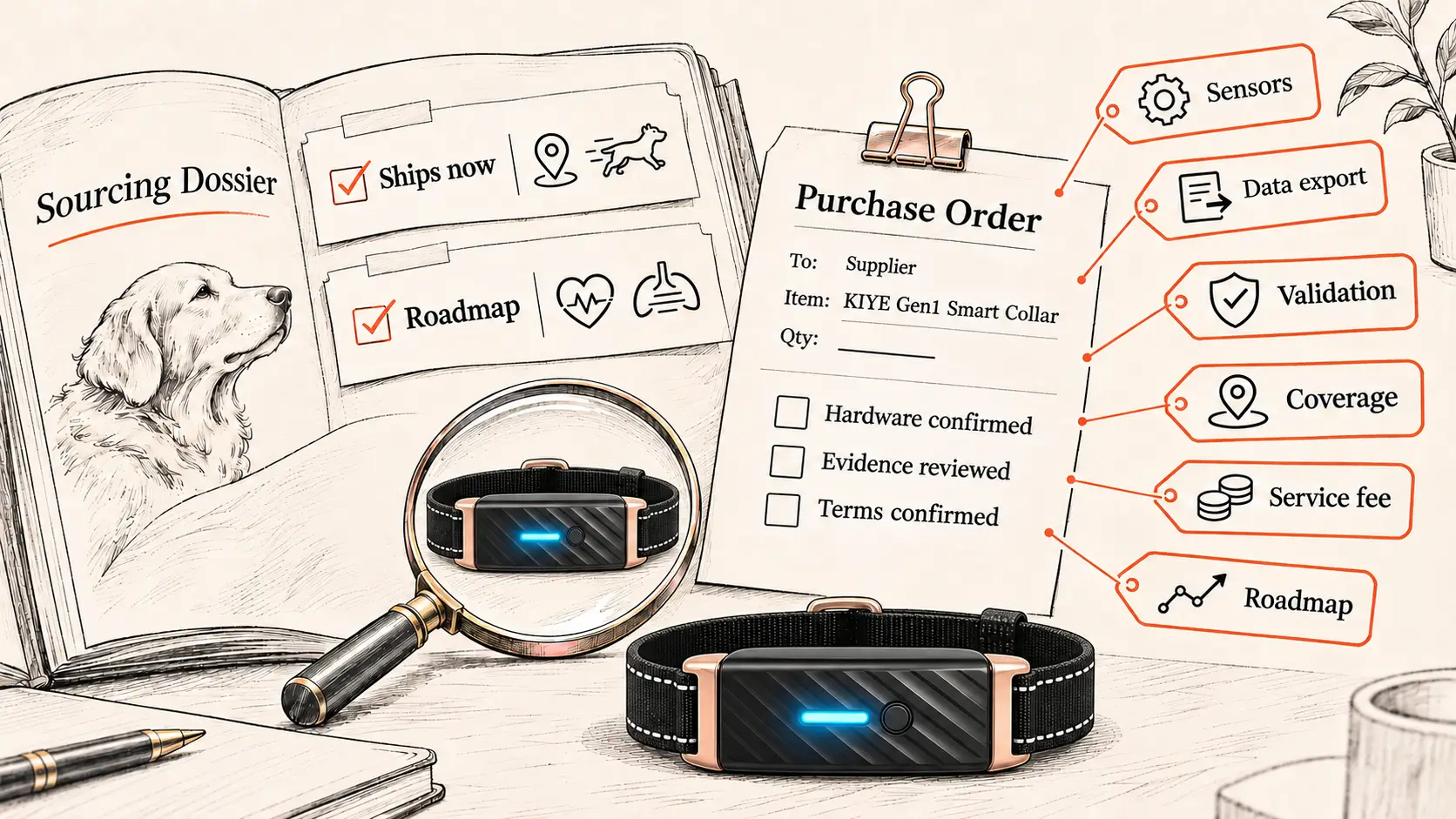
The sensor gap is also a procurement checklist. These are the questions worth asking before a purchase order — and the answers separate a category builder from a return generator.
- Which sensors are actually on the shipping hardware — GPS, accelerometer, or clinical vitals — and which are only promised?
- Can the end buyer export their animal’s data (API, CSV, vet-readable report), or is it trapped inside one app?
- Is any "health" claim backed by third-party validation, or is it marketing language around behavior data?
- Which LTE bands and regional GPS coverage does it support, and is the SIM or eSIM flexible for my market?
- Is the continuous-service fee stated plainly as the standard cost of running GPS and AI reports — or buried?
- Are vitals live today, or clearly on a roadmap? Watch for any line that implies a pulse-reading collar is in the box when it is not.
What Does KIYE Ship Today, and What’s on the Roadmap?
To keep the tiering honest, here is exactly where KIYE stands. The Gen1 KIYE Smart Collar (dog and cat) is built and shipping: GPS positioning plus automatic recognition of a dozen-plus daily behaviors, with a factory-embedded eSIM so the buyer never installs a SIM. Health data is hosted on KIYE servers, but under the Model B platform a partner can build their own app front-end on the API — the data stays portable, not locked. Vitals such as heart rate and temperature are not on Gen1.
They are on the roadmap: the Collar Plus (PPG + infrared, watch-style, physical SIM) for heart rate and temperature, and the KIYE Smart Mattress (PVDF sensor pad) for rest-time heart rate and respiration at home. Both are in development. The AI today delivers behavior baselines and anomaly flags a clinic can read — not a vital-sign monitor. That honest split — location and behavior now, validated vitals later — is the story we tell, because it is the one a distributor can defend in the room.
Is Any of This a Medical Device?
Wellness trends, not a medical device. Smart collars surface trends and gentle flags for conversation with a vet; they do not diagnose. Any health concern should be confirmed with a veterinary professional.
Whatever the sensor tier, the boundary is the same. A collar that notices "activity 20% below this dog’s own baseline for two weeks" is a prompt for a conversation, not a diagnosis. The brands that last in this category hold that line clearly — it protects the buyer, the clinic, and the distributor’s reputation. The job of the hardware is to make the next vet visit better informed, not to replace it.
If you distribute pet tech and want a collar line built on honest sensor tiering, portable data, and a real monitor–support loop, talk to us about partnership: become a KIYE partner.