The smart collar conversation defaults to dogs. The newest US cat ownership data points somewhere else: 53 million cat-owning households, and multi-cat homes up 45% since 2018. For distributors and retail buyers, this is not a niche story. It is a structure that multiplies units per sale — because a health baseline belongs to one pet, and multi-cat households have more than one.
A Demographic Shift the Category Kept Missing
The APPA 2026 Cat Report puts US cat ownership at 53 million households — 39% of all US households, up 5% year over year. That alone is notable. The structural number sits one layer deeper: households with three or more cats grew 7% year over year and are up 45% compared with 2018. Two-cat households also grew 7% year over year. (APPA 2026 Cat Report, via Petfood Industry, September 15, 2026)
US households own at least one cat — 39% of all US households, up 5% YoY (APPA 2026 Cat Report, via Petfood Industry, September 15, 2026)
Growth in US households with three or more cats since 2018 (APPA 2026 Cat Report, via Petfood Industry, September 15, 2026)
The ownership base is changing shape, too. Gen Z now makes up 22% of cat owners, up 10% year over year. Men account for 43% of cat owners, and men with three or more cats are up 117% versus 2018. (APPA 2026 Cat Report, via Petfood Industry, September 15, 2026)
Most smart-collar shelf plans were drawn against dog-buyer assumptions: one device, one active dog, one GPS use case. The cat data describes a different purchase structure — and it is the fastest-moving part of the ownership base.
One Baseline Per Pet: The Structural Argument
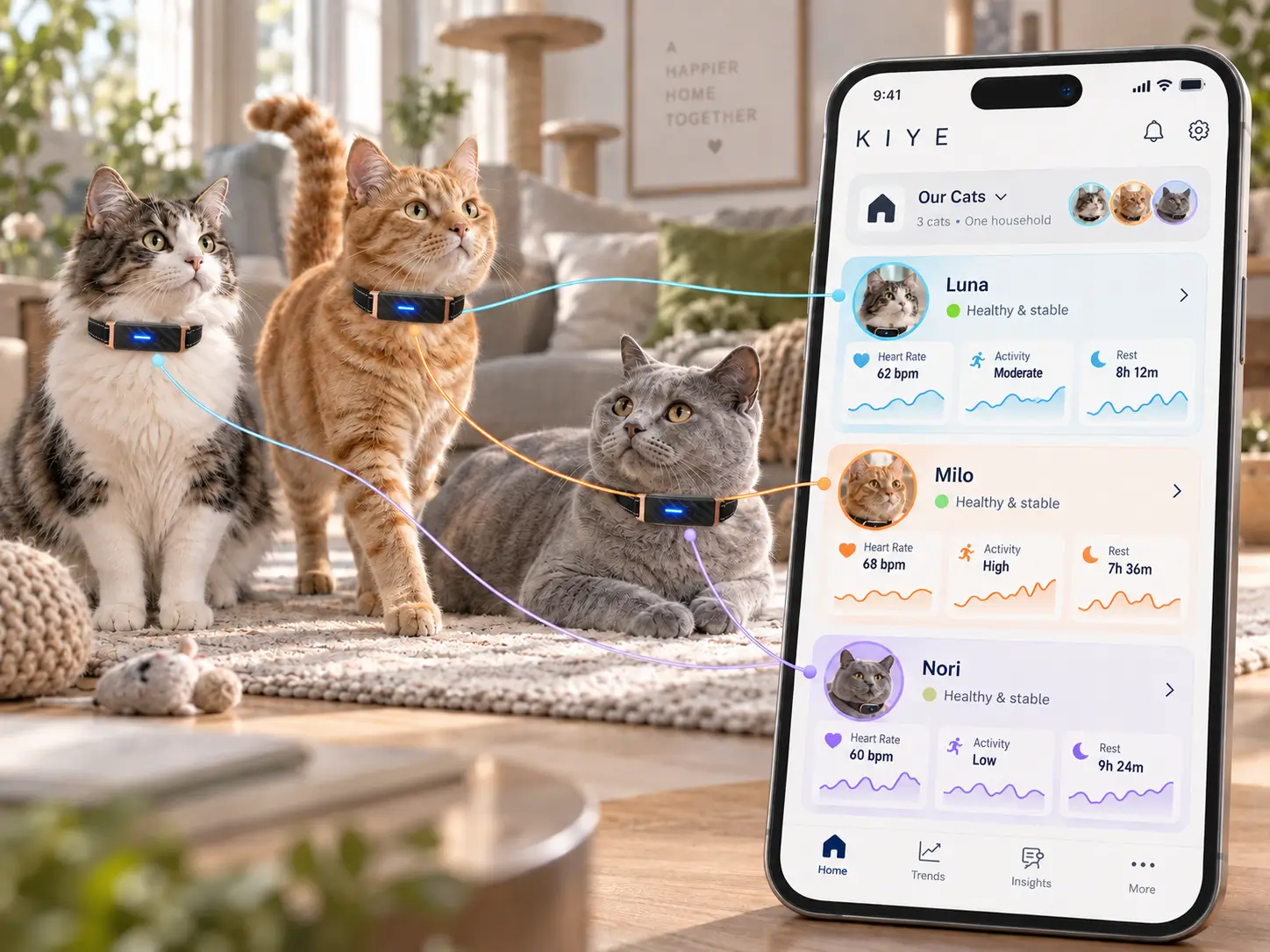
A health baseline is individual. Resting heart rate, respiratory pattern, activity and rest rhythms differ animal to animal — and a trend line only means something when it belongs to the animal it measured. In a two-cat or three-cat household, one device cannot produce two baselines. Adoption therefore means two or three units, plus replacement and accessories over time.
This is the quiet difference between the dog and cat collar businesses. In a single-dog household, the household and the pet are the same unit. In a multi-cat household, the unit of sale is the pet — and the number of pets per household is exactly what has been compounding since 2018. It is also why a smart health collar program should be planned in per-pet quantities rather than per-door estimates.
| Planning question | Dog-first assumption | Multi-cat reality |
|---|---|---|
| Unit of sale | One household, one device | One baseline per pet — two or three units |
| Growth driver | New dog owners | More cats per existing household (+45% since 2018) |
| Repeat revenue | Replacement cycles | Every newly added cat is a new unit |
| Data logic | One trend line | Per-pet baselines that cannot be shared |
Plan collar shelf space per pet, not per household
The practical takeaway for buyers: a three-cat household that adopts continuous monitoring is not one sale — it is three, and each cat added later starts a new one. Facings and starter bundles should be planned against pets, not doors, especially in markets where multi-cat homes are compounding fastest.
The Measurement Question Is Already Answered
The usual objection is that cats are hard to measure. The published evidence says the opposite — and that home measurement is the more representative kind. In a study of 30 healthy cats published in the Journal of Feline Medicine and Surgery, the same cats showed a median heart rate of 153 bpm at home versus 190 bpm in the clinic, and median respiratory rates of 50 versus 58 breaths per minute. Blood pressure rose as well. (JFMS, via Vet Candy, September 10, 2026)
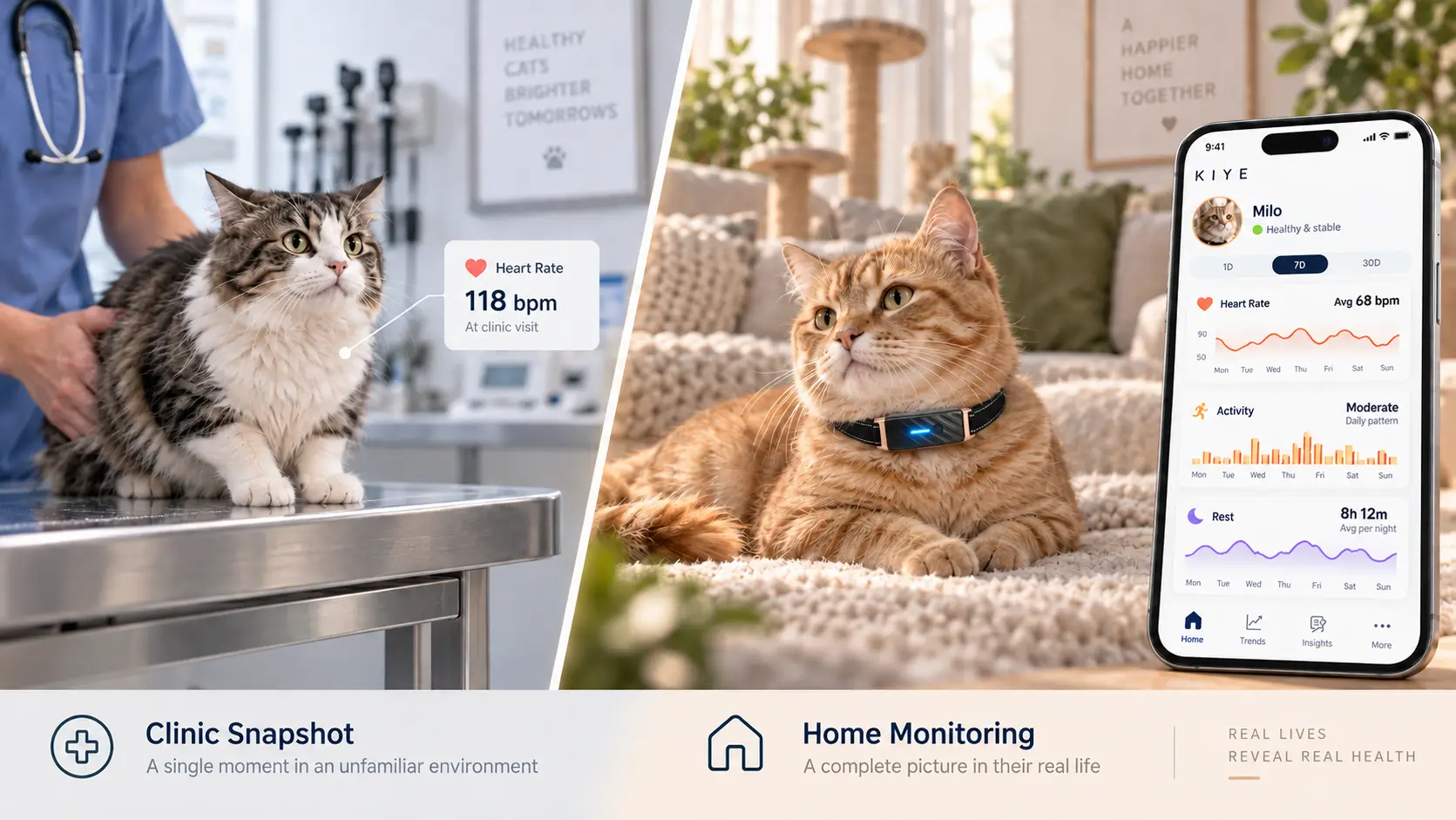
Cats mask stress in clinical settings. The clinic number is not the cat’s normal — the home number is. That is precisely why continuous, at-home monitoring matters more for cats than for any other species.
Owner awareness is moving the same direction. Searches for the Cat Grimace Scale — a validated tool for reading feline pain signals — are up 403% year over year. (Rising Trends, September 2026) More cat owners are actively trying to detect discomfort earlier, and the tools they find first are static charts. A collar that surfaces changes in daily rhythms is the structural upgrade to that behavior.
The hardware side has matured in parallel. Pet wearables are projected to grow from about $3.56 billion in 2026 to $7.23 billion by 2031, with smart collars accounting for roughly 64% of revenue. (Sidewalk Dog, 2026) Validation studies on canine collars have reported resting heart rate accuracy of 99.6% and respiratory accuracy of 98.6% across 703 dogs. (AI-COLLAR study, Frontiers in Veterinary Science, via Sidewalk Dog, 2026) The measurement layer is no longer the bottleneck. Distribution is.
What This Means for Senior Pet Care Distribution
For buyers assembling a senior pet care distribution range, three adjustments follow directly from the data:
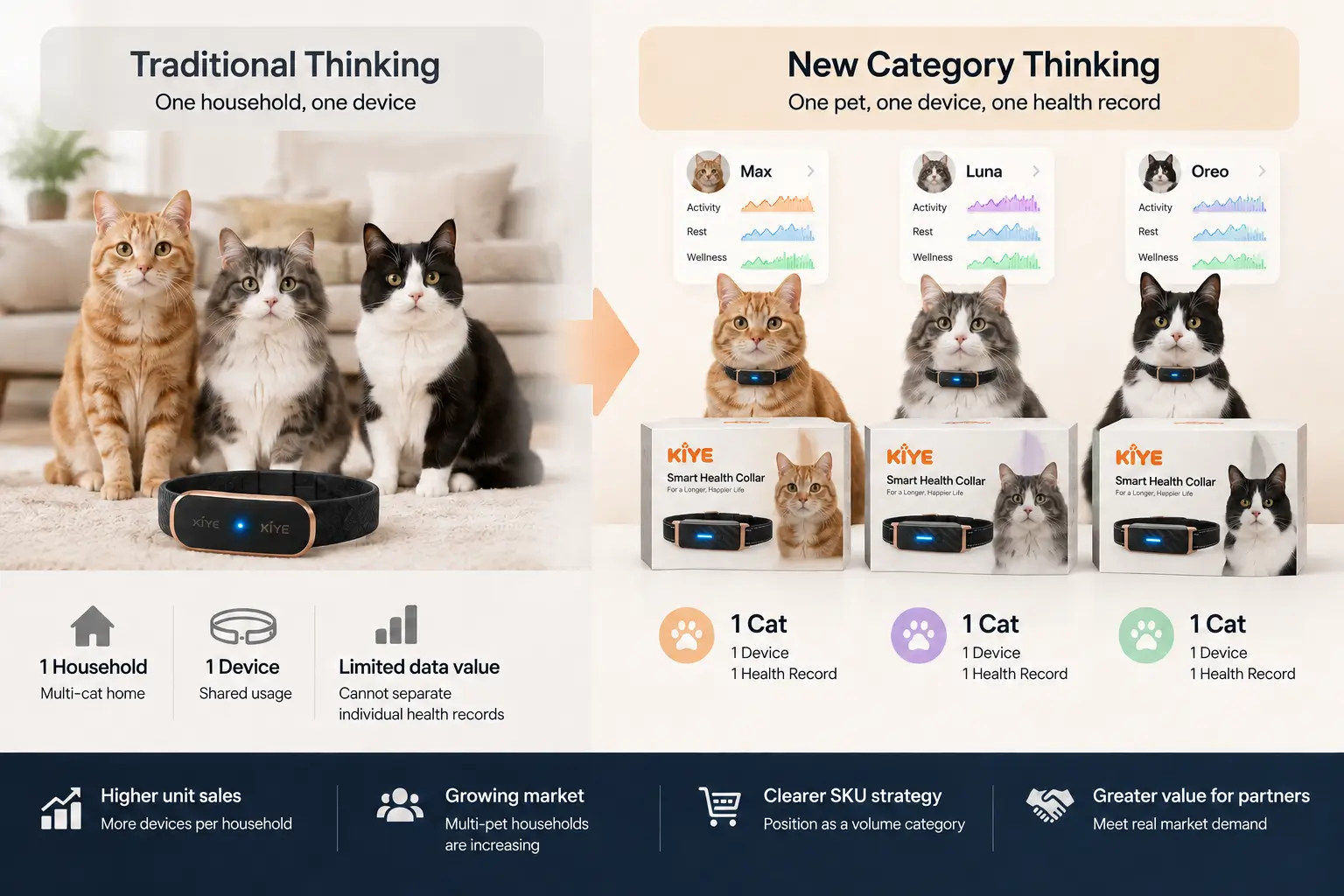
First, treat the cat collar as a volume SKU, not an accessory. A 45% rise in three-plus-cat households since 2018 is a base that buys in multiples. Multi-unit starter packs and per-pet pricing belong on the program sheet from day one.
Second, message the baseline, not the gadget. The reason a multi-cat household needs two devices is not feature greed — it is that trend data is meaningless unless it belongs to one animal. Buyers who can explain that in one sentence will convert the multi-cat segment faster than any feature comparison.
Third, position monitoring as the entry point for senior cats. Cats age quietly; owners notice change late. The Cat Grimace Scale search growth shows the demand for earlier detection already exists. A pet health collar supplier program that frames continuous monitoring as the first step of senior cat care meets that demand at the shelf.
Where the Rest of the System Fits
KIYE’s Smart Health Collar is designed for both dogs and cats — the data layer in this article applies to the full cat opportunity described above. The nutrition side of KIYE’s 3-in-1 system, Senior Pet Nutrition with AM/PM timed support, is a senior dog nutrition line; the closed loop of monitoring, analysis, and nutritional support currently completes on the dog side.
For cats, monitoring is the entry point — and for senior dogs, collar data plus AM/PM senior dog nutrition forms the continuous-tracking loop that turns a one-time device sale into an ongoing replenishment relationship. Buyers can see how the two sides connect on why KIYE is structured this way.
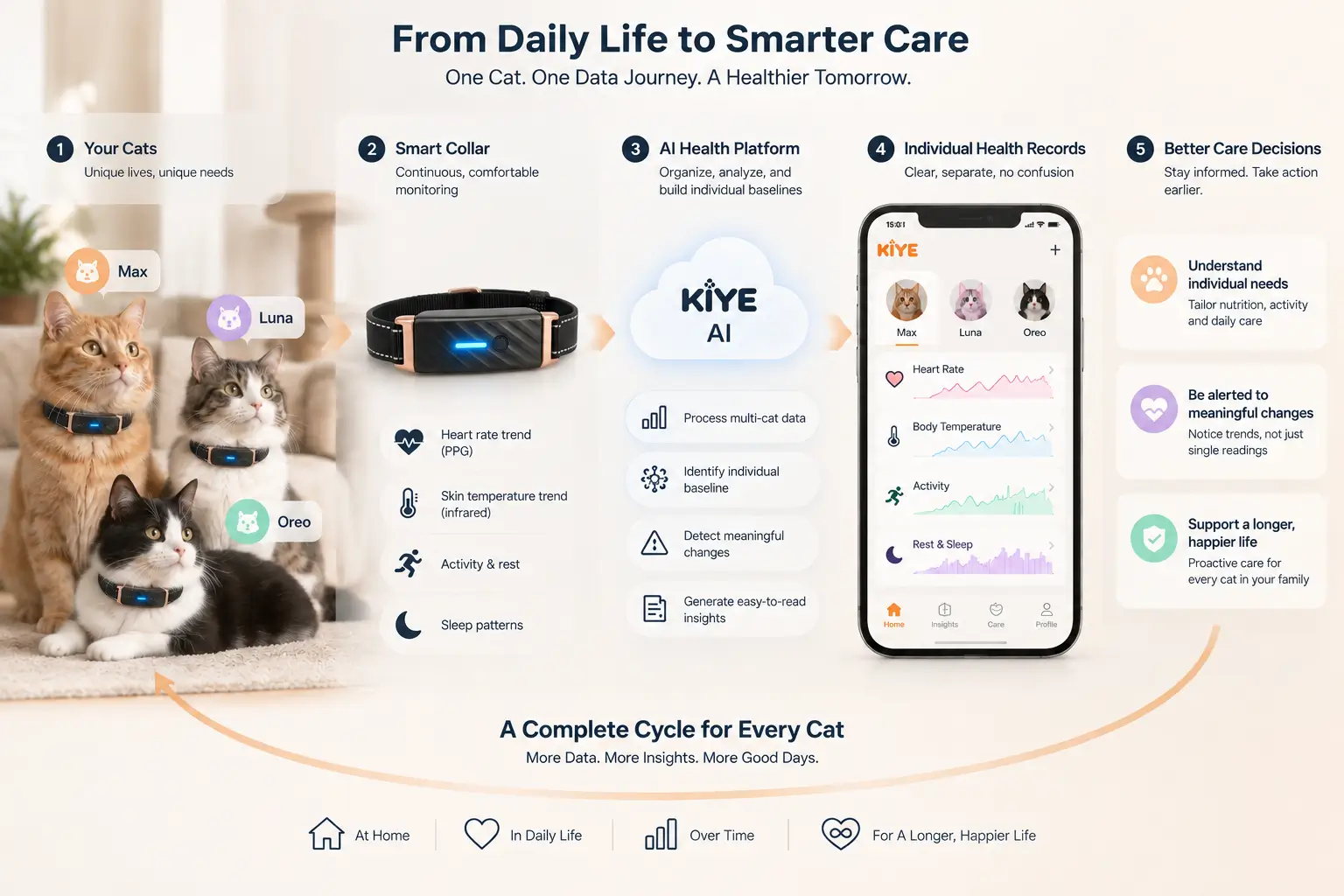
The APPA cat numbers describe where collar volume grows. The senior dog side shows where the model compounds. A range that carries both — planned per pet, not per household — is the version of senior pet care distribution this data supports.
Sources
- Petfood Industry (September 15, 2026). Report: Cat ownership grows to 53 million US households — APPA 2026 Cat Report.
- Animal Health News (September 16, 2026). US cat ownership reaches 53 million households as Gen Z and male ownership grows.
- Journal of Feline Medicine and Surgery, via Vet Candy (September 10, 2026). Heart and respiratory rates in 30 healthy cats: home versus clinical settings.
- Rising Trends (September 2026). Cat Grimace Scale search volume +403% YoY.
- Sidewalk Dog (2026). Pet wearables market outlook 2026–2031; AI-COLLAR study, Frontiers in Veterinary Science (703 dogs).
Stock the Pet, Not the Household
KIYE’s Smart Health Collar covers dogs and cats with continuous wellness monitoring, and our senior dog nutrition line completes the loop where replenishment lives. Review collar specifications, multi-unit program options, and FBA-ready packaging — or request samples for your market. Reach us at info@kiyepet.com.