Quick Answer
A closed-loop senior pet health system should do more than collect data or send alerts. It should continuously monitor relevant wellness signals, check whether the data is usable, compare changes with each pet’s personal baseline, explain what changed, guide an appropriate next step and continue tracking after that action. The system should connect wearable data, AI-assisted interpretation, owner observations, veterinary care and responsible nutrition support—without presenting a consumer device as a substitute for professional diagnosis.
Medical disclaimer: KIYE is a wellness-monitoring system, not a diagnostic device. It is not intended to diagnose, treat, cure or prevent disease. Wearable data and AI-assisted reports should not replace veterinary examinations, laboratory testing, imaging or professional medical advice. If a pet shows acute symptoms—such as collapse, breathing difficulty, seizure, severe pain, repeated vomiting or inability to urinate—seek veterinary care immediately.
Why Is Continuous Monitoring Alone Not Enough?
A conventional pet tracker may record location, distance or daily activity. A more advanced wearable may also collect heart-rate trends, temperature trends, rest patterns or movement-related signals.
But collecting more data does not automatically produce better care.
A pet owner may receive an alert saying that activity has fallen by 20%, yet still be left with several unanswered questions:
Is the change temporary or persistent?
Is it associated with weather, travel, reduced exercise, poor collar fit or a possible health issue?
Did other supported signals change at the same time?
Should the owner continue observing, contact a veterinarian or seek urgent care?
If a routine or nutrition adjustment is made, how will the response be tracked?
A closed-loop system should help answer these questions. Its purpose is not simply to generate more measurements. Its purpose is to turn longitudinal information into a safer and more understandable care process.
The 2023 AAHA Senior Care Guidelines for Dogs and Cats emphasize that senior-pet care is multifaceted and may involve medical care, behavioral management, environmental modification, nutrition and awareness of multiple concurrent conditions. A responsible technology platform should support that broader process rather than imply that one device can replace it.
What Are the Essential Parts of a Closed-Loop System?
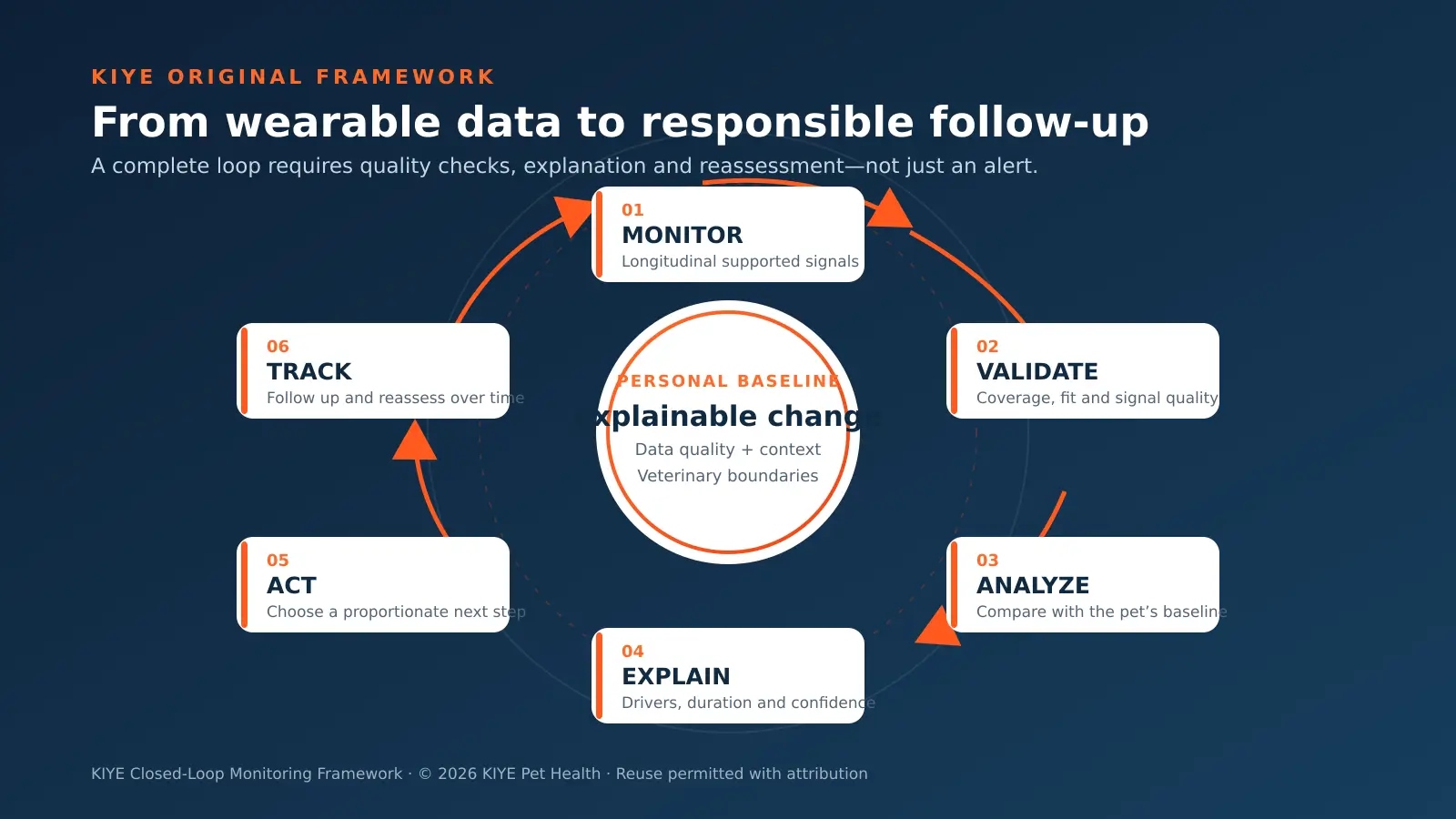
A credible closed-loop senior pet health system should include six connected stages:
Continuous data collection
Data-quality and context checks
Personal baseline development
Explainable trend analysis
Appropriate care or nutrition action
Follow-up monitoring and reassessment
If one stage is missing, the loop remains incomplete.
| Stage | Primary question | Expected output |
|---|---|---|
| Monitor | What is happening over time? | Longitudinal activity, rest, movement, location and supported physiological trends |
| Validate | Is the data reliable enough to interpret? | Coverage, fit, signal-quality and missing-data checks |
| Analyze | What changed from this pet’s normal pattern? | Personal-baseline comparison and persistent deviations |
| Explain | Why was an alert generated? | Clear drivers, duration, context and data-quality information |
| Act | What is the safest next step? | Observe, document, consult a veterinarian or consider an appropriate care adjustment |
| Track | What happened after the action? | Follow-up trends, tolerance, adherence and reassessment |
Figure 1. The KIYE Closed-Loop Monitoring Framework. Data collection becomes useful only when quality checks, personal-baseline analysis, explainable interpretation, proportionate action and follow-up tracking remain connected. © 2026 KIYE Pet Health. Reuse permitted with attribution and a link to this article.
The system should also allow owners to add context. Travel, grooming, hot weather, boarding, medication changes and unusual exercise can all influence wearable data.
What Should a Senior Pet Collar Monitor?
No single metric can describe a pet’s complete health. A useful system should combine complementary information while clearly communicating what each signal can and cannot show. KIYE’s Smart Health Collar is being developed around this principle: longitudinal wellness and safety information should add context, not be presented as an independent diagnosis.
Activity and movement patterns
Activity data can help identify sustained changes in movement volume, intensity or timing. For a senior dog, a gradual decline in morning activity or fewer normal transitions may justify closer observation.
However, lower activity is nonspecific. It may be associated with routine, heat, anxiety, fatigue, discomfort or illness. Activity data should generate questions—not diagnoses.
Rest and daily rhythm
A wearable may estimate rest duration, interruptions and changes in the pet’s day-and-night routine. Increasing nighttime interruptions can provide useful context when combined with owner observations.
A collar does not perform a clinical sleep study. “Estimated rest interruptions increased” is an appropriate observation. “The dog has a sleep disorder” is not.
Heart-rate trends
Heart-rate information may be useful when it is collected during sufficiently reliable, low-motion periods. The system should distinguish resting trends from measurements affected by exercise, excitement, movement, coat, contact or collar fit.
A collar-based heart-rate trend is not an electrocardiogram and should not be used independently to diagnose cardiovascular disease.
Temperature trends
Wearable temperature information is most appropriately interpreted as a relative trend against the pet’s own usable baseline. Ambient temperature, coat density, sensor contact and collar fit may influence readings.
A wearable measurement should not be described as equivalent to clinical core temperature unless that equivalence has been specifically validated for the device and intended conditions.
Gait- and posture-related movement features
Accelerometers and gyroscopes may identify repeatable movement characteristics, such as activity intensity, transitions or changes in gait-related patterns.
These features may help an owner notice functional change, but they cannot independently identify arthritis, hip disease or the location of an orthopedic injury.
Location and safety information
GPS tracking and electronic safety zones can help owners locate a pet or identify unexpected movement. Location is primarily a safety capability, but it may also provide context—for example, by showing whether reduced activity reflects a shorter walk, a different routine or time away from home.
Why Does Every Pet Need a Personal Baseline?
A universal target cannot fully represent an individual pet.
A 12-year-old retriever, an 8-year-old Chihuahua and an indoor senior cat have different routines, movement patterns and environmental exposures. Even two dogs of the same breed and age may have very different normal activity levels.
A personal baseline describes what is typical for one pet under sufficiently usable observation conditions. It may account for:
time of day;
weekday and weekend routines;
normal exercise intensity;
age and life stage;
recent environmental conditions;
typical rest patterns;
reliable physiological measurement periods;
gradual long-term behavioral change.
A mature system should update this baseline carefully. If an unusual pattern persists for several weeks, an algorithm should not immediately absorb it and begin treating it as normal.
Personal baselines also need transparent limitations. The user should be told when insufficient wear time, missing data or poor signal quality prevents a dependable comparison.
What Makes an AI-Assisted Health Report Explainable?
An AI-assisted report should not be a black-box score.
If a report displays “Wellness Score: 64,” the user should be able to see which supported observations contributed to that result. A useful report should answer five questions:
What changed?
Compared with which baseline?
How long did the change persist?
How complete and usable was the data?
What is the safest next action?
For example:
“Estimated nighttime rest interruptions were 38% above this dog’s four-week baseline for four consecutive nights. Morning activity also decreased. Data coverage was high. Check for routine or environmental changes and contact your veterinary practice if the pattern persists or is accompanied by symptoms.”
This wording explains the observed pattern without naming a disease.
By contrast, a statement such as “Your dog is developing arthritis” would go beyond what consumer wearable data can establish independently.
How Should a Closed-Loop System Connect Data With Nutrition?
Nutrition can be part of a senior-pet care loop, but wearable data should never trigger an automatic supplement sale. KIYE’s Senior Pet Nutrition range is positioned as complementary AM/PM wellness support rather than as a treatment selected automatically from collar data.
The WSAVA Global Nutrition Guidelines support an individually tailored nutrition plan based on a broader nutritional assessment. Relevant information may include diet history, body weight, body condition, muscle condition, activity level and identified risk factors.
Wearable data may contribute useful longitudinal context, but it cannot determine the complete nutrition plan.
A responsible workflow should follow this sequence:
Confirm what changed and assess whether veterinary evaluation is needed.
Review the pet’s complete diet, treats and current supplements.
Assess body weight, body condition and muscle condition.
Review appetite, stool quality, water intake, medications and known conditions.
Define one specific, measurable nutrition or routine objective.
Make a bounded adjustment with a clear dose, duration and stop rule.
Continue monitoring tolerance and relevant trends.
Escalate to a veterinarian if symptoms persist or worsen.
This approach is particularly important for senior animals because body weight alone may not reveal muscle loss. WSAVA distinguishes body condition, which primarily reflects fat stores, from muscle condition, which may change with aging or disease.
What Is KIYE’s Current Product Scope?
KIYE is developing a connected senior-pet health platform built around three components:
a smart collar for collecting supported movement, wellness and safety information over time;
AI-assisted reports that organize longitudinal information and identify changes from a pet’s personal baseline;
an AM/PM nutrition-support program designed for middle-aged and senior dogs.
Available collar metrics and services depend on the final device configuration, software version, market, data coverage and released specification. KIYE product pages and commercial documents should identify the exact functions included in each configuration.
KIYE’s current nutrition range is positioned as complementary wellness support:
AM Vitality: Designed to support healthy digestion, joint mobility and daily gut balance.
PM Comfort: Designed to support digestive comfort, normal bowel regularity, healthy skin and a naturally glossy coat.
These products are not medicines and should not be presented as treatments for disease.
Final public claims should always match the released hardware specification, validated functions, packaging language and applicable requirements in each target market.
Which KIYE Capabilities Are Still Research and Development Goals?
KIYE’s longer-term research direction includes exploring how longitudinal data may support more advanced senior-pet health insights.
Potential research areas include:
improved motion-noise filtering for wearable physiological signals;
analysis of heart-rate variability under validated measurement conditions;
more detailed gait- and posture-feature modelling;
multimodal trend analysis across activity, rest and physiological information;
improved integration of owner observations and veterinary findings;
evaluation of associations between nutrition or routine changes and longitudinal wellness trends;
future risk-estimation models developed with appropriate clinical data.
These are research objectives, not current diagnostic capabilities.
KIYE should not claim that its system predicts a specific disease, calculates the probability of an arthritis episode or confirms a medical condition unless the exact model has undergone appropriate validation and the intended claim is permitted in the relevant jurisdiction.
This distinction between released capability and research direction is essential for long-term trust.
How Should the System Respond to an Alert?
A useful alert should lead to one of four response levels.
| Alert context | Appropriate response |
|---|---|
| Isolated deviation with an ordinary explanation | Check collar fit, weather, schedule and recent exercise; continue monitoring |
| Persistent change without obvious symptoms | Record owner observations and monitor closely |
| Persistent multi-signal change or noticeable symptoms | Contact the veterinary practice and share the trend report |
| Acute distress or emergency signs | Seek urgent veterinary care immediately |
The app should never tell an owner to wait when the pet is showing serious clinical symptoms simply because a wellness score appears normal.
How Can Owners and Veterinarians Use the Same Data?
Veterinarians generally need concise, contextual information rather than hundreds of unexplained readings.
A useful veterinary summary should include:
the date range;
data coverage;
the pet’s baseline;
the main deviations;
relevant graphs;
owner-observed symptoms;
diet and supplement history;
medication changes;
recent environmental or routine changes.
Wearable information may strengthen the history available to the veterinary team, but diagnosis still depends on the pet’s clinical presentation and appropriate professional evaluation.
The AVMA overview of veterinary telehealth also reinforces an important boundary: technology may support communication and care delivery, but applicable veterinarian-client-patient relationship requirements and professional judgment still matter.
Frequently Asked Questions
Can a closed-loop pet health system diagnose disease?
No. A consumer wellness system can identify and organize changes in supported signals, but it cannot independently diagnose disease. Diagnosis requires veterinary assessment and, when appropriate, laboratory tests, imaging or other clinical procedures.
Can a smart collar identify a change before the owner notices symptoms?
It may identify a sustained change before that change becomes obvious during occasional observation. This does not mean the device has identified the cause or predicted a specific disease.
Does every alert require a veterinary appointment?
No. Some alerts may result from heat, unusual exercise, travel, collar fit or missing data. The report should explain the context and recommended response. Persistent changes, multiple aligned signals or clinical symptoms deserve professional attention.
Can KIYE automatically recommend a supplement from collar data?
No. Wearable data may help identify what should be assessed, but it should not automatically prescribe a nutritional product. Diet history, body and muscle condition, symptoms, medications and veterinary input may all affect the decision.
Can the collar replace routine senior-pet examinations?
No. Continuous home monitoring can add information between appointments, but it cannot replace preventive examinations, diagnostics or veterinary care.
Are KIYE’s future disease-risk models already available?
No. Advanced disease-probability models remain a research direction unless KIYE specifically announces a validated and released capability with supporting methodology.
The Practical Standard for Closed-Loop Senior Pet Care
A meaningful closed-loop system should not begin and end with a notification.
It should:
collect longitudinal data;
verify that the data is usable;
compare the pet with its own baseline;
explain persistent changes;
recommend an appropriate level of response;
support responsible care and nutrition decisions;
continue tracking after an adjustment;
involve veterinary professionals when medical evaluation is needed.
This is the standard behind the KIYE connected senior-pet health system: Monitor → Analyze → Support → Track → Better Health. It is a care framework—not a claim that a consumer wearable can diagnose disease or replace veterinary judgment.
The goal is not to turn every data change into a product recommendation. The goal is to help people see meaningful changes earlier, communicate more clearly and make better-informed decisions throughout a pet’s senior years.
Learn More About KIYE’s Monitoring Methodology
For a transparent explanation of supported metrics, data-quality checks, personal baselines, alert logic, known limitations and current validation status, read the KIYE Health Monitoring and Data Methodology.
References
American Animal Hospital Association. 2023 AAHA Senior Care Guidelines for Dogs and Cats.
World Small Animal Veterinary Association. Global Nutrition Guidelines and Nutrition Toolkit.
American Veterinary Medical Association. Veterinary Telehealth: The Basics.
U.S. Food and Drug Administration. Animal Food Labeling and Pet Food Claims.
- –
Exploring Senior Pet Health Solutions for Your Market?
KIYE combines connected wearable monitoring, AI-assisted wellness insights and responsible nutrition support within one senior-pet health proposition for distributors, retailers and strategic partners.