
In September 2026, three major retailers highlighted similar operational priorities through public discussions and industry reporting: recurring revenue is moving out of food and medicine and into more of the shelf. For pet retail buyers and distributors this matters more than any category growth figure, because it changes what a supplement increasingly needs to be before it is worth a listing. Not only what it contains, but whether a retailer’s system can reorder it without somebody deciding again.
From a retailer’s plan to your listing decision
The signal travels one line:
Retail objective → Subscription infrastructure → SKU requirements → Buyer selection criteria
Each step turns a channel ambition into something a supplier has to prove on paper. The rest of this article works back from the last step.

What three retailers signalled in September 2026
None of the following was announced as a supplier programme. All three were comments about where each business intends to grow, made in public investor settings and reported by industry trade press. Read together they point to a shared direction.
| Who | What was said | What it changes for a buyer |
|---|---|---|
| A large US pet e-commerce retailer | It plans to use pet profile signals to extend its subscription programme beyond food and medicine into other categories, and any future acquisition would be in health | Expect subscription onboarding for non-food SKUs; prepare pack specs a system can schedule |
| A national rural-lifestyle and pet retailer | Subscription revenue is around USD 200 million this year and growing at triple digits, most of it from pets | Recurring-ready SKUs gain a structural edge in ranging; pilot-grade products lose shelf time |
| A US pet specialty chain | It has consolidated its own-brand portfolio from many labels down to seven, and customers using its full ecosystem spend around five times more per year than single-channel customers | Fewer slots, deeper relationships: a SKU must justify repeat purchase or it will not hold a slot |
| Both the e-commerce retailer and the chain | Neither intends to compete on promotion | Promotion is a less reliable growth lever, so plan for organic reorder, not re-sell |
Source: public investor conference remarks reported by industry trade press, September 2026. Companies are not named here.
Why this is a shelf question, not a retail-operations question
When a retailer decides that recurring revenue is the plan, every SKU has to survive one test: can it be reordered automatically? That test has two consequences for the supplier side of the relationship.
First, the system has to know when the next unit is needed. That sounds like logistics. It is actually a product-specification question, because it depends on how much the customer uses per day and whether that number is fixed.
Second, if the system cannot compute it, the SKU falls back to being sold again and again — by a promotion, by a counter assistant, by habit. And promotion is precisely the lever both retailers said they would not pull. A product that needs to be re-sold at the shelf every cycle is asking for a resource the channel has just said it is not spending.
The narrowing own-brand portfolio points the same way. Going from many labels to seven means fewer internal competitors for external brands, but it also signals a higher bar for what stays: the retailer is choosing depth over breadth, and depth only pays out on SKUs that repeat.
The test has moved
For most of the last decade, a supplement earned its listing by what it claimed on the front of pack. Under a recurring model it also has to earn it in the back office — as a pack size and a daily amount that a replenishment system can schedule without a human guess. That is not a marketing question and it cannot be answered by the ingredient panel.
What a subscription-ready SKU increasingly needs
Three things, all of which can be checked before a purchase order is signed, and none of which call for a market forecast.
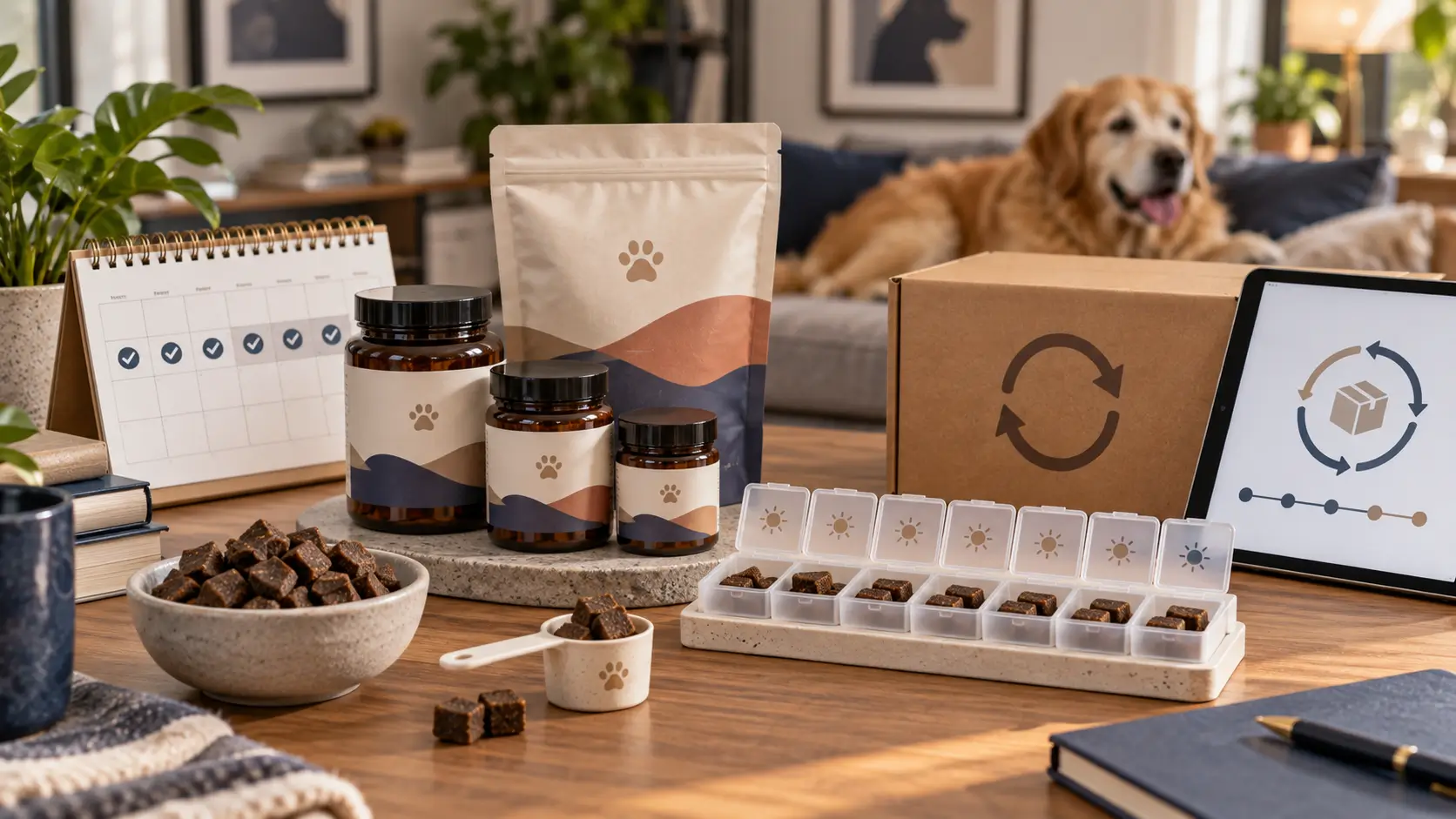
1. Dose and pack size can be standardised
If the recommended daily amount depends on the owner guessing, no system can compute a reorder date. Weight-banded dosing solves this: one soft chew a day for a dog under 14 kg, a defined amount for 14–25 kg, another above 25 kg. The question stops being open-ended and becomes a number the channel can plan inventory against.
Ask the supplier this, in writing: for a 9 kg dog and a 32 kg dog, what exactly is the daily amount, and how many days does one pack last? A supplier who answers with a range rather than a rule has told you the SKU cannot be scheduled.
2. The use action follows a fixed daily rule
“As needed” cannot be subscribed. Neither can “twice weekly during flare-ups”. A once-daily routine can. This is also why day-parted routines fit recurring models better than single-serving products: when the day has structure — a morning chew and an evening chew — the pack inherits that structure, and the reorder date stops being an estimate.
3. There is a reason to continue that the customer can see
Subscription removes the repurchase decision from the counter. It does not remove it from the household. If month three looks exactly like month one, cancellation is the cheapest option the customer has, and it is one click away.
We have written separately about feedback-loop length — how long it takes the person paying to tell whether anything changed — and it applies directly here. Subscription does not solve that problem. It relocates it into the customer’s own home, where the supplier has far less ability to answer it.
The cost of getting it wrong
Under a traditional shelf model, a disappointing product declines quietly. Sell-through softens, the buyer notices two quarters later, and the range gets trimmed at the next review.
Under a recurring model the same disappointment arrives as a cancellation event and a review, inside the same dataset the retailer is using to decide which categories to extend recurring into next. That is the real exposure for a distributor: not a gradual loss of listing, but exclusion at the exact moment the largest player in the market is choosing where to point its replenishment engine.
What this means for senior dog nutrition
Senior dog nutrition is the hardest honest test of all three checks. It is a daily routine, which helps. It is also long-horizon and hard to observe, which does not.

KIYE structures the category in three layers:
Monitor
The KIYE Smart Health Collar supports continuous observation of activity, rest and related wellness trends in dogs and cats.
Understand
The AI Health Platform organises change against the individual pet’s own baseline rather than a generic category claim.
Support
AM Vitality and PM Comfort form a day-and-night nutrition routine for senior dogs, dosed by weight band — under 14 kg, 14–25 kg and over 25 kg — at one soft chew a day.
None of this is a promise about outcomes. Collar data does not diagnose or treat anything and is not a substitute for clinical assessment. The commercial argument is narrower and it is exactly the loop this article has been building toward: a weight-banded daily rule makes the pack computable for a replenishment system, and a continuous at-home trend gives the household a reason to keep looking between two deliveries. That loop — observe, compare against the pet’s own baseline, keep the routine — is the data feedback loop that check three asks for. Those are the two properties a recurring slot increasingly rewards, and they are why a collar-plus-nutrition routine holds a subscription better than a product that goes quiet after the first month.
A buyer checklist for subscription readiness
- Dose and pack can be standardised. For a 9 kg and a 32 kg dog, ask for the exact daily amount and the pack length in days. A range instead of a rule means the SKU cannot be scheduled.
- Use follows a fixed daily rule. “As needed” and “during flare-ups” cannot be subscribed. A once-daily or day-parted routine can, because the pack inherits the structure.
- There is a visible reason to continue. The household can see something change between two deliveries, or month three cancels. Continuous at-home data is one way to give them that reason.
- The supplier can show the loop, not just the label. A product that proves its routine through observation survives review; one that goes quiet after month one does not.
The question to put to every supplier
Not which category is growing. This one:
For a 9 kg dog and a 32 kg dog, how many days does one pack last — and what will the owner be able to notice by the end of it?
If a supplier cannot answer the first half, the SKU cannot be scheduled and will be re-sold at the shelf every cycle, using a budget the channel has said it is not spending. If they cannot answer the second half, it will not survive month three inside a subscription. Either way you have learned something a category growth figure would never have told you.
Supply terms, batch traceability and FBA-ready packaging are the other half of the conversation; you can see how we structure them on the KIYE partner model page.
Sources
- Industry trade press reporting on public investor conference remarks, September 2026: a large US pet e-commerce retailer plans to use pet profile signals to extend its subscription programme beyond food and medicine, and would acquire only in health; a US pet specialty chain has consolidated its own brand to seven labels and reports ecosystem customers spending around five times more per year than single-channel customers; both stated they would not compete on promotion.
- Same reporting, September 2026: a national rural-lifestyle and pet retailer reported subscription revenue of approximately USD 200 million for the year, growing at triple digits, most of it pet-derived. One company’s disclosed figure; not a channel-wide estimate.
- KIYE product specification: AM Vitality and PM Comfort, senior dog nutrition, weight bands under 14 kg / 14–25 kg / over 25 kg, one soft chew daily.
This is a commercial screening framework, not a market forecast or a clinical efficacy assessment. Subscription performance depends on channel, category and execution. Longitudinal monitoring supports trend observation and does not diagnose medical conditions or replace veterinary evaluation.
Check the pack, not just the panel
If you are rebuilding a supplement range for a channel that is moving to recurring, ask for the daily rule and the pack length before you ask for the ingredient story. Request specifications and samples, or write to info@kiyepet.com to discuss channel fit.