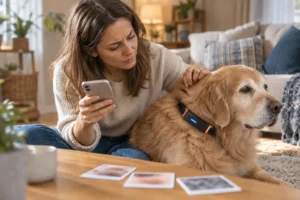
Aging pets often hide discomfort until changes become visible. By then, owners may have missed valuable context. Connected monitoring offers an earlier, clearer path to supportive care.
Why Is the Aging-Pet Monitoring Market Expanding?
Pet owners increasingly treat dogs and cats as family members, while longer lifespans make age-related changes more visible. The practical challenge is simple: pets cannot explain that their sleep has changed, their activity has fallen, or their breathing feels different. Owners typically notice a problem only after it affects appetite, mobility, behavior, or daily comfort.
That gap between an early signal and a visible symptom is creating demand for tools that can establish a pet’s normal baseline and show how it changes over time. The opportunity is especially relevant for middle-aged and senior pets, whose health is rarely defined by one dramatic event. More often, the useful story is a gradual pattern.
According to industry projections cited in the source report, the global smart pet collar market is estimated at approximately USD 1.225 billion in 2025 and is projected to reach about USD 4.993 billion by 2032, representing an estimated compound annual growth rate of roughly 22.6%. The global pet health monitoring device market is separately estimated at about USD 872 million in 2025 and projected to reach approximately USD 1.684 billion by 2032.
Why aging pets make continuous context more valuable
A single activity score tells an owner very little. A four-week pattern showing lower activity, more fragmented rest, and a change in respiratory trend provides context worth reviewing. It does not diagnose disease, but it can make observations more specific and conversations with a veterinarian more informed.
A grounded way to think about value is “fewer blind spots,” not “more alerts.” A useful system should suppress ordinary noise, highlight sustained change, and explain what the owner can reasonably do next.
How Have Smart Pet Collars Evolved Beyond Tracking?
Early connected collars were largely location products. They answered a high-stakes but occasional question: Where is my pet? Newer products combine GPS, virtual boundaries, activity and rest monitoring, selected physiological trends, behavioral analysis, multi-user access, and app-based history.
The source material describes two marketplace examples that gained traction by combining functions rather than relying on a single feature. One integrated AI health monitoring, location, and a virtual fence for medium and large dogs. Another combined GPS, boundaries, activity and rest trends, household sharing, and longer battery life. The lesson is not that every collar needs every feature. It is that buyers respond to a coherent job-to-be-done.
The Apple Watch analogy—and its limit
The category resembles the smartwatch market before Apple Watch became a health platform. Early watches could count steps and show notifications, yet data alone did not create lasting value. Adoption deepened when systems began interpreting signals and presenting timely, understandable prompts.
Pet wearables may follow the same path, with one important difference: the wearer cannot describe symptoms or confirm how they feel. Interpretation must therefore remain cautious, baseline-aware, and clearly separated from diagnosis.
| Dimension | Single-Function Tracker | Integrated Health System |
|---|---|---|
| Primary question | Where is my pet? | What is changing, and what should I consider next? |
| Typical inputs | Location or activity | Location, activity, rest, supported health and behavior trends |
| Output | Raw status or alert | Contextual trend, explanation, and proportionate next step |
| Relationship | Event-based usage | Ongoing engagement and longitudinal history |
| Best role | Recovery and basic tracking | Continuous care support; not diagnosis |
From tracking hardware to an integrated health experience
What Determines Whether a Pet Health System Succeeds?
1. Baselines matter more than isolated numbers
Dogs differ by age, breed, size, environment, and routine. A useful platform learns what is normal for the individual pet and looks for meaningful deviations. This is particularly important for senior dogs, whose activity may be lower than a young dog’s but stable and appropriate for them.
2. Interpretation must lead to an appropriate action
An alert without context creates anxiety. A better output explains the pattern, its duration, and a proportionate next step: continue observing, review routine factors, provide supportive care, or consult a veterinarian. The system should never imply that consumer monitoring replaces a clinical assessment.
3. Hardware must disappear into daily life
Accuracy is irrelevant if the collar is uncomfortable, rarely charged, difficult to sync, or removed after a week. Fit, battery behavior, durability, water resistance, app clarity, and simple household sharing are not secondary specifications. They determine data continuity.
4. The experience must extend beyond the device
A collar may identify change, but owners still need a practical response. KIYE’s approach connects the Smart Collar with understandable insights and daily nutritional support, creating a care experience that continues after a signal appears.
What Is the KIYE Signal-to-Support Loop?
KIYE’s continuous-care philosophy can be expressed as an original four-stage framework: the Signal-to-Support Loop. It keeps the technology focused on an owner’s real decision rather than on a dashboard full of numbers.
The KIYE Signal-to-Support flow
Sense
The wearable captures consistent activity, rest, location, and supported health-related trends during normal life.
Interpret
AI compares recent patterns with the pet’s established baseline, seeking sustained or combined changes rather than reacting to every fluctuation.
Support
The owner receives plain-language guidance that may include observation, routine adjustments, nutrition support, or a recommendation to seek professional advice.
Review
The system follows subsequent patterns to show whether the change persists, resolves, or deserves closer attention. This closes the loop between noticing and caring.
This framework is the core of Why KIYE continuous care: monitoring is useful only when it improves understanding and supports an appropriate response.
Where Is Aging-Pet Technology Going Next?
From population averages to individual baselines
Future systems will increasingly distinguish “unusual for this pet” from “unusual for pets in general.” That shift should reduce irrelevant alerts and make long-term trend reports more useful.
From one device to connected care ecosystems
Collars will connect more naturally with feeding, nutrition, household routines, and professional care. The strongest platforms will not simply add features; they will preserve one understandable record across touchpoints.
From dashboards to shareable summaries
Owners do not need to interpret dozens of charts. They need concise summaries: what changed, when it changed, whether it persisted, and what contextual factors may matter. Exportable trend reports can also help owners provide veterinarians with better observations, while leaving diagnosis to qualified professionals.
From hardware margins to ongoing service value
As components become easier to replicate, durable differentiation will come from data quality, interpretation, onboarding, customer education, and recurring support. For channel partners, this can create a longer customer relationship than a one-time accessory sale.
What Is the Opportunity for Distributors and Retail Partners?
For distributors, retailers, Amazon sellers, and pet health partners, the category creates an opportunity to move beyond commodity collars. Aging-pet solutions address a defined life stage, a meaningful owner concern, and an ongoing need for education and support.
A strong channel proposition should answer five questions: Is the target pet clear? Is the owner benefit understandable in seconds? Does the product fit daily routines? Are health claims appropriately controlled? And does the ecosystem create a reason for the customer to remain engaged after purchase?
The commercial advantage is not merely a higher-priced device. It is the ability to build a relevant senior-pet category around monitoring, interpretation, supportive routines, and long-term care. That gives partners more opportunities for education, repeat engagement, and complementary sales without turning health anxiety into a sales tactic.
A More Useful Definition of Smart
The next generation of smart pet collars will not be judged by how many numbers they display. It will be judged by whether those numbers help an owner notice meaningful change, understand it responsibly, and support an aging pet with greater consistency.
For KIYE, the goal is not to make hardware the hero. The goal is to help owners see what pets cannot say—and turn that understanding into continuous, practical care.
If you are looking to bring differentiated senior-pet solutions to your market, explore partnership options with KIYE.
Source and Editorial Note
Primary source material: “Pet Health Monitoring: When Smart Hardware Starts to Understand Pets” (Chinese-language report supplied by KIYE). Market-size figures above are estimates reproduced from that source. Before public release, KIYE should add the original market-research publisher names, report titles, publication dates, and URLs where available.