
Novel ingredients can create meaningful opportunities in pet nutrition. New proteins, delivery formats, fermentation technologies and functional compounds may all contribute to better products.
But novelty answers only one question: What is different about this product?
For an aging dog or cat, the more important question is: What evidence shows that this formulation is appropriate, transparent and worth monitoring over time?
That distinction matters because senior pet nutrition should not be judged by how modern an ingredient sounds. It should be judged by whether its composition can be verified, whether the evidence matches the claim and whether changes in the individual pet can be observed responsibly.
Novel Ingredients Are Moving Faster Than the Evidence
On September 14, 2026, Czech biotechnology company BeneMeat publicly urged the UK government to preserve the country’s ability to assess novel foods through its own scientific and regulatory pathway. The company said uncertainty surrounding a proposed UK–EU sanitary and phytosanitary agreement had already affected investment, partnerships and commercial planning.
The BeneMeat story was primarily about regulatory autonomy and the commercialization of emerging food technologies. It was not evidence that cultivated meat—or any other novel ingredient—improves outcomes in senior pets.
That difference provides a useful lesson.
A regulatory pathway determines whether an ingredient may enter a market. It does not, by itself, tell a pet parent or category buyer whether a finished formula will support the needs of one individual senior animal.
“Allowed,” “innovative” and “scientifically interesting” are not interchangeable with “effective for this pet.”
What “Proven” Should Mean in Senior Pet Nutrition
“Proven” should not mean old, conventional or resistant to innovation. A novel ingredient can be well supported, while a familiar ingredient can be poorly formulated or inadequately disclosed.
Instead, a credible standard for senior pet nutrition should consider several different layers of evidence:
- Ingredient evidence: Is there relevant research supporting the individual active ingredient?
- Finished-formula evidence: Has the actual combination, dose and delivery format been evaluated?
- Manufacturing verification: Are active amounts, batch testing, Certificates of Analysis and manufacturing information available?
- Individual follow-up: Is there a responsible way to observe tolerance and relevant changes after the nutrition plan begins?
These layers should not be treated as substitutes for one another. Research on an individual ingredient does not automatically validate a finished formula. A clean laboratory report does not establish clinical effectiveness. A change observed at home does not, by itself, prove that the product caused it.
“New” describes what changed in the product. “Proven” describes whether the claim is supported by the right level of evidence.
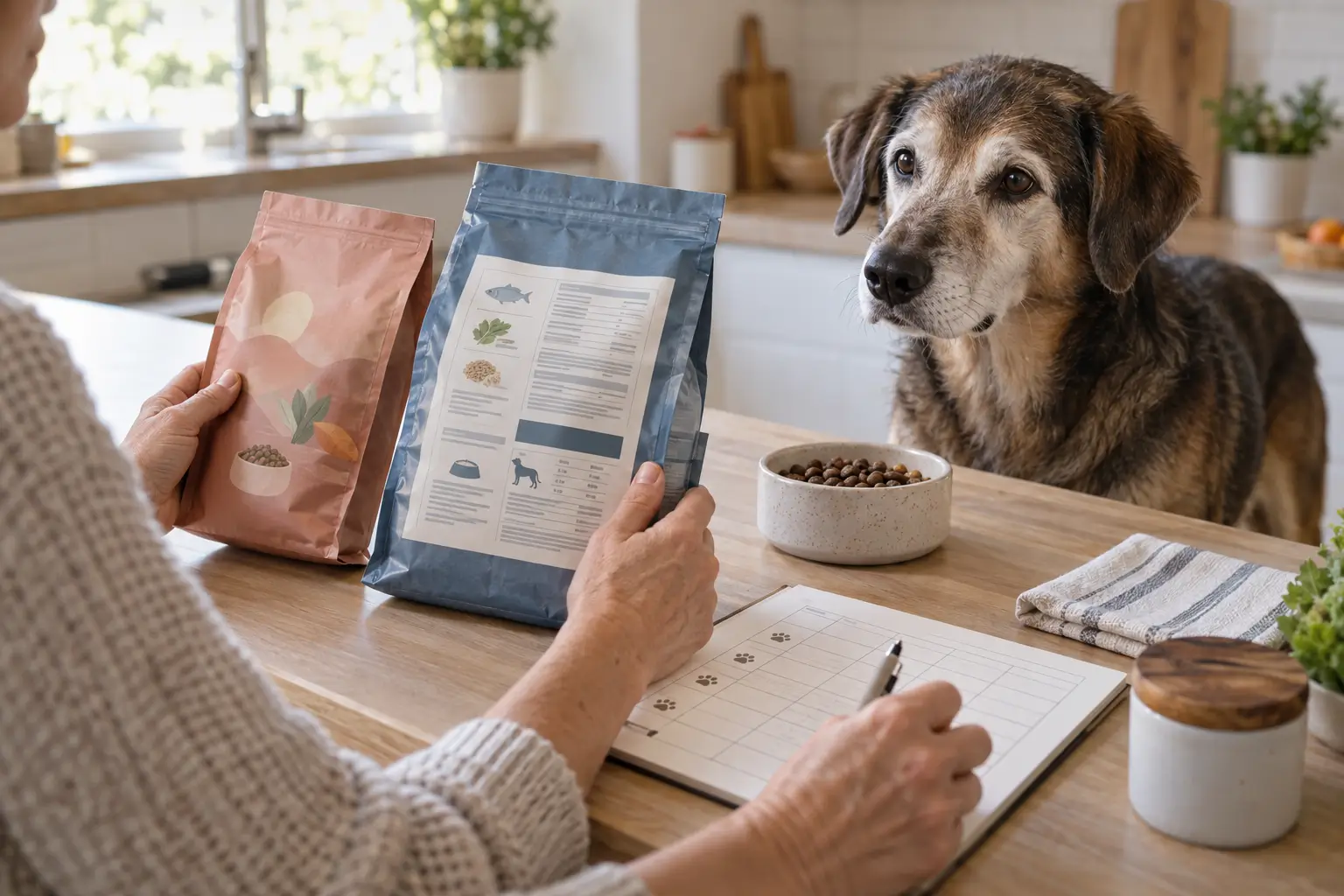
Why Senior Pets Raise the Evidence Bar
Senior pets are not simply younger adults with a different label. Aging can affect appetite, digestion, activity, rest, body condition and muscle condition. Older animals are also more likely to have established routines, existing conditions, medication schedules or multiple products in use at the same time.
That makes context essential.
A formula that appears well tolerated in a healthy young adult may not be equally appropriate for an older animal with a different diet history, activity level or veterinary care plan. Even two dogs of the same age and breed may respond differently because their normal routines and personal baselines are not the same.
This is why age alone is an incomplete decision tool. “Senior” is a category; it is not an individual baseline.
A more responsible approach considers:
- the pet’s complete diet, treats and current supplements;
- body weight, body condition and muscle condition;
- appetite, digestion and tolerance;
- activity and rest patterns;
- medication or routine changes;
- the specific objective and duration of the nutrition adjustment.
Pet parents should involve a veterinarian when an older animal has symptoms, diagnosed conditions, prescription diets or ongoing medication. A nutritional product should complement responsible care—not replace it.

The Transparency Gap: What Buyers Can Actually Verify
Pet supplement marketing often uses phrases such as “science-backed,” “clinically tested” or “veterinarian formulated.” Those terms are useful only when a buyer can see what evidence sits behind them.
A 2026 transparency review published by supplement company La Petite Labs and summarized by Today’s Veterinary Business highlighted how uncommon finished-formula evidence and public verification remain across the category.
The latest version of the Pet Supplement Brand Transparency Report reviewed 56 ranked brands and reported that:
- only three had published a peer-reviewed clinical trial on a finished formula;
- only seven allowed buyers to trace a specific lot number to its own laboratory report before purchase;
- only seven disclosed the named manufacturing facility behind their products;
- 23 used veterinary-credibility language without naming a veterinarian that buyers could verify.
These findings require context. La Petite Labs sells products in the same category and explicitly describes the report as an editorial publication—not independent third-party certification. The review measures public transparency, not product safety, effectiveness, ingredient quality or customer satisfaction.
Even with those limitations, the report identifies a practical problem: buyers are often asked to trust claims that are difficult to examine before purchase.
A more defensible nutrition product should make it easier to find:
- clearly disclosed active amounts;
- evidence that matches the actual claim;
- named experts and their specific roles;
- relevant testing and batch documentation;
- realistic language that does not turn ingredient research into a finished-product promise.
Longitudinal Data Adds What Packaging Cannot
A product label can describe ingredients and intended support. It cannot show what happened to an individual pet after the product entered the daily routine.
This is where longitudinal home data can add useful context.
Instead of relying on a single impression, pet parents can compare a defined period before and after a nutrition adjustment. Relevant questions may include:
- Did normal activity or rest patterns change?
- Was the change sustained or limited to one unusual day?
- Did appetite, schedule, exercise, medication or weather also change?
- How does the current pattern compare with the same pet’s established baseline?
A 2025 prospective observational study published in Frontiers in Veterinary Science followed 703 apparently healthy dogs wearing an Invoxia biometric collar for a median of 189 days.
The study demonstrated the value of long-term home data for understanding how resting heart rate and respiratory rate varied with factors including age, body size, circadian rhythm, season and breed.
However, it was not a nutrition-intervention study, the median dog age was 3.8 years and the device used a different sensing method from KIYE. The paper also disclosed that three of its authors were employees of the device manufacturer. Its findings support the broader feasibility of longitudinal home monitoring, but they should not be presented as validation of the KIYE Smart Health Collar or any nutrition formula.
How KIYE Supports a More Verifiable Feedback Loop
KIYE’s approach brings together Smart Monitoring × AI Intelligence × Day & Night Nutrition.
The purpose of this connected model is not to turn every data change into a product recommendation. It is to make follow-up more structured and to give pet parents and care teams better longitudinal context.
The KIYE Smart Health Collar is designed to organize supported wellness information such as activity, rest, PPG heart-rate trends and infrared surface-temperature trends. KIYE’s connected platform can then present longer-term patterns and comparisons with the pet’s personal baseline.
The KIYE Day & Night Nutrition System provides complementary AM and PM nutritional support for aging dogs through AM Vitality and PM Comfort.
Together, the system can support a more disciplined sequence:
- Establish a baseline: Observe the pet’s normal activity, rest and supported wellness trends before making a change.
- Define the adjustment: Record when the nutrition plan begins, the serving routine and the intended wellness objective.
- Continue observation: Track relevant trends consistently rather than judging the result from one day or one reading.
- Review the context: Consider exercise, weather, travel, medication, appetite and other routine changes.
- Decide responsibly: Continue, reassess or seek veterinary guidance based on the complete picture.
This makes change more observable. It does not automatically establish that the nutrition plan caused the change, diagnose a medical condition or replace veterinary evaluation.

What to Look for Before Choosing a Senior Pet Nutrition Product
Whether you are a pet parent evaluating one product or a retail buyer reviewing a category, ask questions that can be answered with evidence rather than adjectives.
- Are the active ingredients and amounts clearly disclosed?
- Does the cited research evaluate the ingredient, the finished formula or both?
- Are laboratory reports or batch-specific Certificates of Analysis available?
- Are named veterinarians, nutrition professionals or scientific reviewers publicly identified?
- Does the language describe realistic nutritional support rather than treatment or guaranteed outcomes?
- Is there a clear serving routine, observation period and reason to reassess?
- Can changes be compared with the individual pet’s normal baseline?
New ingredients should not be rejected simply because they are new. They should be held to the same standard as every other nutrition claim: appropriate evidence, transparent formulation, responsible communication and observable follow-up.
Proven Should Mean Verifiable
The future of senior pet nutrition will include new ingredients, smarter delivery systems and more connected care. Innovation is not the problem. Unverifiable claims are.
For senior pets, “proven” should not be reduced to one study, one badge, one laboratory report or one encouraging week at home. It should describe a chain of evidence that buyers can examine:
What is in the product? Why is it included? What evidence supports the claim? What changed after use began? What else may explain that change?
That is the standard KIYE is working toward: not novelty for its own sake, but a more transparent and repeatable way to connect daily nutrition with longitudinal at-home observation.
For distributors, wholesalers, retailers and e-commerce partners evaluating the senior pet category, learn more about Why KIYE or explore the KIYE partnership program.