Pet owners are confident they can read their own animals. When tested, most cannot — and that gap is now the most useful thing a distributor can know before committing shelf space to a health monitoring range. It tells you what the product actually has to do once the customer gets it home.
What the identification gap actually looks like
A veterinary telehealth platform surveyed 2,000 US pet owners in January and February 2026, then showed them images of common conditions and asked what they were looking at. (GlobalPETS, September 17, 2026)
Over half of respondents — 54% — said they believed they could tell the difference between allergy-related and parasite-related problems in cats and dogs. The images said otherwise. (GlobalPETS, September 17, 2026)

of surveyed US pet owners could not identify a flea-bite rash on a cat; 60% could not identify the same condition on a dog
(GlobalPETS, September 17, 2026)
of dog owners correctly identified ringworm when shown an image
(GlobalPETS, September 17, 2026)
The pattern holds across conditions, and it is worse for cats than for dogs.
| Condition shown | Cat owners correct | Dog owners correct |
|---|---|---|
| Tick bite | 47% | 71% |
| Ringworm | 16% | 1% |
| Skin mites | 12% | 10% |
| Allergies | 20% | 11% |
Recognition rates among 2,000 US pet owners shown images of common conditions. (GlobalPETS, September 17, 2026)
Two further numbers matter for anyone selling into this category. Half of respondents — 51% — already worry about their pets being exposed to parasites. And while 59% said they would consult a veterinarian in person when symptoms appear, 44% said they would search online first. (GlobalPETS, September 17, 2026)
That last figure is the commercial point. Owners are not disengaged. They are motivated, worried, and already reaching for an answer — they simply do not have a reliable way to produce one.
Why “more data” is not the answer
The category’s default response to this kind of finding is to add sensing: more metrics, higher sampling frequency, a longer specification sheet. That response misreads the problem.
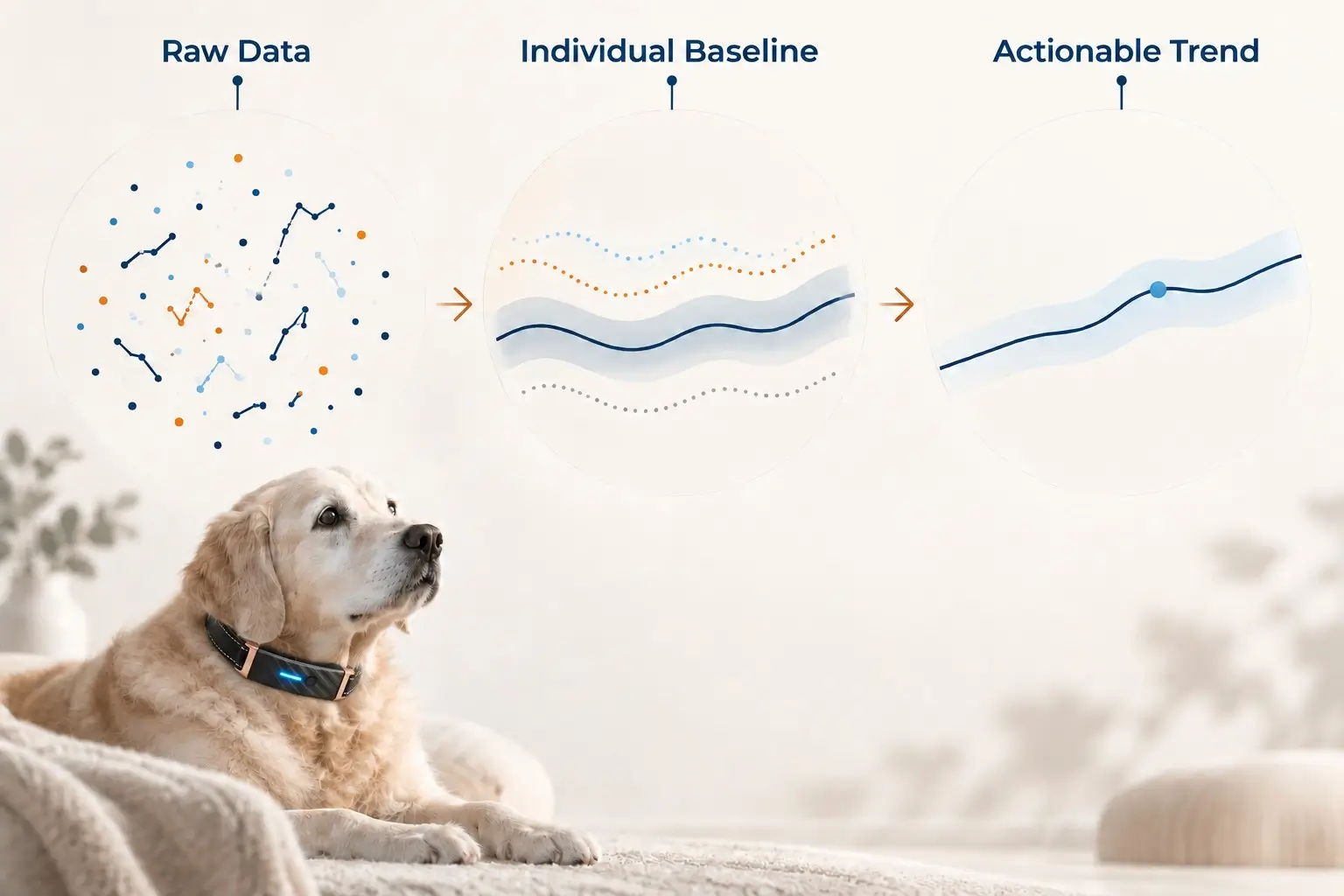
The constraint is not how much is measured. It is whether the person holding the result can tell what it means for this animal. A resting heart rate is only actionable if the reader knows whether that number is unusual for their own pet today, not for the average of the breed.
The competitive line has moved from sensing to interpreting
Distributors who keep buying on sensor count will end up with inventory that customers cannot act on. The scarce feature in 2026 is not another measurement — it is a product that tells an owner which number moved, on which animal, and whether that movement is worth a phone call. This is a claim you can disagree with, and it is testable: ask any retailer how many monitoring devices get abandoned in month two.
Population averages do not do this work. Neither do breed averages, because the spread inside a breed is wider than the spread between breeds on most resting metrics. What the survey results point to is a requirement for an individual baseline: a reference built from the same animal over time, against which a change can be named.
What this changes about how you evaluate a monitoring product
If the bottleneck is interpretation, the evaluation checklist changes accordingly. Most sourcing conversations still open on hardware specifications, which are necessary but no longer sufficient.
| Usual evaluation question | What the survey suggests asking instead |
|---|---|
| How many metrics does it track? | Does it name which number changed, for this animal? |
| What is the stated sensor accuracy? | Is accuracy stated against an individual baseline or a population average? |
| How long does the battery last? | Will it still be on the animal in month six? |
| What is the unit margin? | What does the retailer say at the shelf to justify it? |
The fourth row is the one that decides the order. A monitoring device that cannot be explained in one sentence at the shelf becomes a discount item, and discount items do not build a category.
Where the collar fits — and where it does not
The KIYE Smart Health Collar collects activity, rest and wellness-related data continuously, and it is designed for both dogs and cats. That species coverage is not a footnote here, because the survey shows cat owners consistently identifying conditions less accurately than dog owners — 47% versus 71% on tick bites, for example. (GlobalPETS, September 17, 2026)
In households where the animal is a cat, the interpretation layer carries more of the load, not less.
The boundary matters just as much as the capability. Collar data supports wellness awareness. It surfaces changes and helps identify patterns worth discussing with a veterinarian. It does not diagnose, does not treat, and does not replace clinical assessment — and any supplier positioning otherwise is creating liability for the retailer downstream.
What the interpretation layer means for your range
Scale is already there. In the US, 52% of dog-owning households and 50% of cat-owning households include a pet aged seven or older, a share that has held near 50% since 2019. (Packaged Facts, 2026 US Pet Market Outlook) For these animals, “something seems off” is the most common observation an owner makes and the least actionable one they have.
This is where senior pet care distribution stops being a demographic story and becomes a merchandising one. The retailer’s job is to stock something that converts a vague worry into a specific next step, because that is the moment the customer either spends or walks.
In practice, the products that hold margin in this segment share one property: they answer a question the customer already has. Not “do you want more data about your pet” — nobody asks that. Rather, “is this change worth a vet visit”. That is the standard worth applying across any senior pet care distribution range you are reviewing this season.
Turning a symptom gap into a repeat-purchase category
Monitoring establishes the baseline and flags the change. It does not, on its own, give the owner something to do on Tuesday morning. That is the commercial role of the second half of the range.
KIYE Senior Pet Nutrition is built around the daily rhythm of an aging dog, with an AM and PM split rather than a single daily serving. For a distributor, the structural difference from a monitoring-only line is straightforward: hardware is bought once, nutrition is bought every month, and the collar is what makes the nutrition defensible rather than generic.
The connection is the part worth selling. An owner who has seen a trend line for their own dog is a different customer from one who has not — the senior dog nutrition conversation starts from a specific observation instead of a general claim. That is also what makes the category repeatable rather than one-and-done.
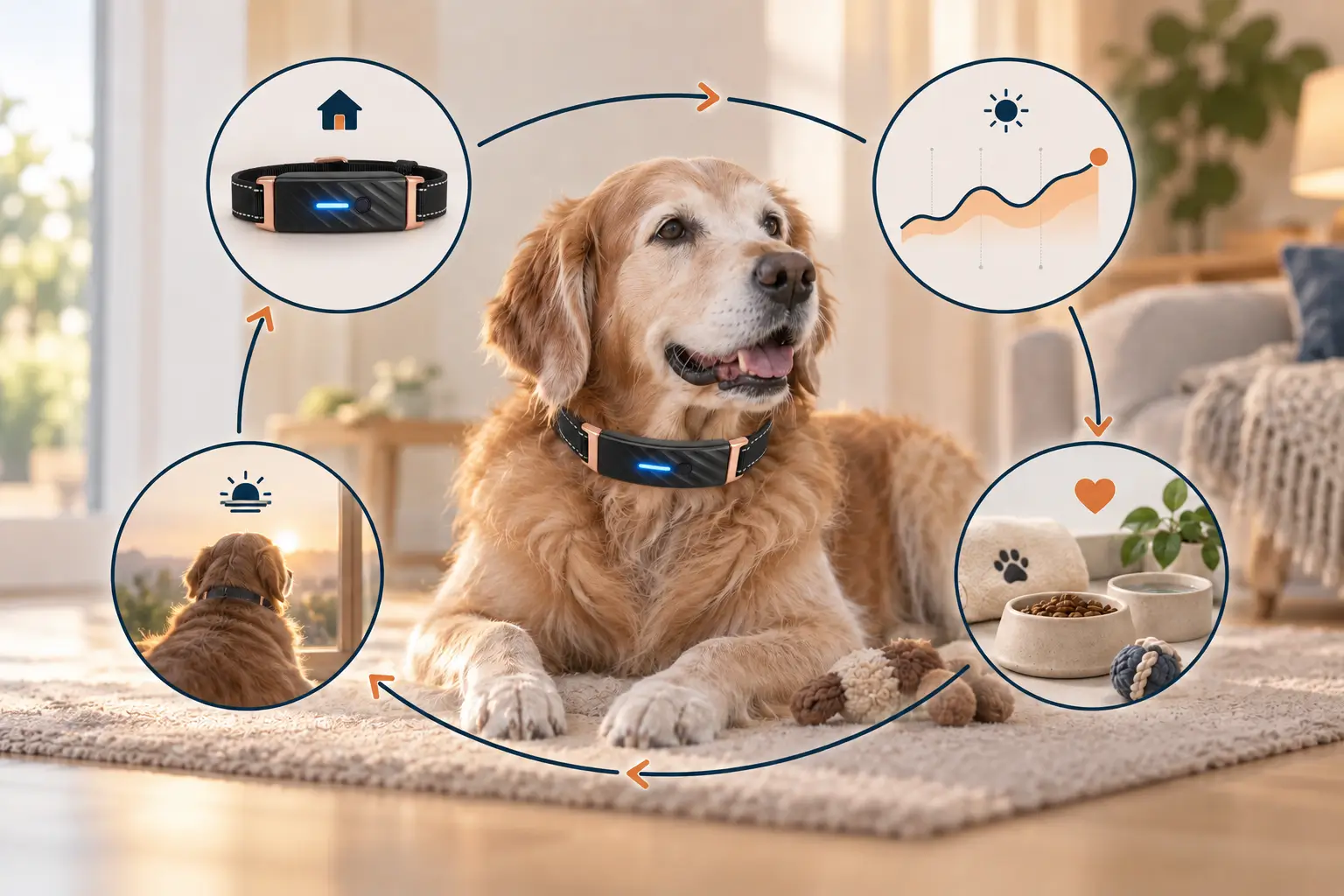
For buyers planning senior pet care distribution for the coming season, the sequencing is the takeaway: stock the layer that produces the observation, then stock the layer the owner acts on. Ranges built the other way around tend to stall at the first reorder.
You can review how we structure that pairing, including sample programmes and co-branding, on the KIYE partner model page.
Sources
- GlobalPETS — “US pet owners struggle to spot parasites, research finds,” September 17, 2026. Survey of 2,000 US pet owners conducted January–February 2026 by a veterinary telehealth platform.
- Packaged Facts — 2026 US Pet Market Outlook: 52% of dog-owning households and 50% of cat-owning households include a pet aged 7 or older.
Stock the layer that answers the customer’s question
If your health range is being evaluated on sensor count, it is worth a second look at what happens after the first month of use. Request specifications and samples, or write to info@kiyepet.com to discuss channel fit.