Why 2026 Is the Inflection Point
For the first two years of the pet-wearable boom, “AI” on a collar meant a daily cuteness score or a barks-translated-into-emoji gimmick. That phase is ending. In several markets, AI health-reporting has quietly become a commodity layer — the underlying models and report generators are now reusable middleware that any hardware brand can license. Even adjacent livestock wearables now ship with open APIs and multimodal sensing at low cost. The practical consequence for buyers: “has AI” is no longer a differentiator. What the AI does, and who can read its output, is the only thing that matters.
The Demo Trap
Most consumer AI features on collars stop at novelty. A chatbot that “translates” barks, a happiness percentage, a notification that says “your dog seems relaxed today.” These may lift app opens for a week. They do not change a clinical decision, and they give a distributor no reason for a retailer to reorder. For a B2B buyer, an AI feature earns shelf space only if it reduces risk, saves staff time, or gives the end customer a reason to keep the device on past month three. A talking dog fails all three tests.

What a Veterinary Clinic Actually Needs
Clinics are not buying entertainment. They are buying signal they can act on. When a practice evaluates a smart collar, these four capabilities separate a tool from a toy.
Trend data, not snapshots
A single resting-heart-rate reading means little. A 90-day baseline that shows a gradual drift in activity or sleep is what prompts a follow-up visit. The AI’s job is to build the longitudinal view — not to scream at every blip.
Reports a vet can read in 60 seconds
The output should be a shareable summary a clinic can drop into a patient record: PDF, CSV, or an API into practice software. If the data only lives inside a consumer app, it is useless at the point of care.
Interpretable flags, not a black box
“Activity 18% below this dog’s own baseline for 12 days” is actionable. “Your dog is sad” is not. Clinics need wellness flags they can explain to an owner — with the clear boundary that this is not a diagnosis.
Built for the senior dog, not the puppy
The highest-value use case is the aging pet: slower recovery, changing sleep, early mobility loss. AI tuned for geriatric baselines is far more useful to a practice than a generic “activity score.”
What a Distributor Should Demand Before Stocking
From a procurement lens, the AI is only one part of a larger package. These are the questions a serious B2B buyer should ask the brand before signing.
- Data you can carry. Ask whether the platform exposes an API and whether the end buyer can export their own animal’s history. A device whose data is trapped in one app becomes a churn risk for everyone down the chain. (With KIYE’s Model B, health data is hosted on KIYE servers but the partner can build their own app front-end on the API — the data stays portable, not locked.)
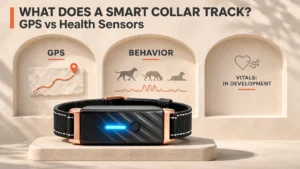
- Honest tiering between what ships and what’s promised. Be wary of any line that implies vitals like heart rate or temperature are live today when the hardware only does GPS and behavior recognition. A defensible roadmap — GPS + behavior now, validated vitals later — beats vague “AI health” with clinics every time.
- Integration potential, not isolation. The strongest collar AI this year is the kind that can feed insurance programs or clinic networks. Pet wearables that cannot export will look dated fast next to open-API competitors.
- A realistic view of the annual fee. Continuous GPS and AI-generated reports cost money to run, and the industry prices this as a standard subscription. Treat it as table stakes, not a differentiator — and never let a prospect believe the hardware is “free to run.”

Where the Loop Beats the Chatbot
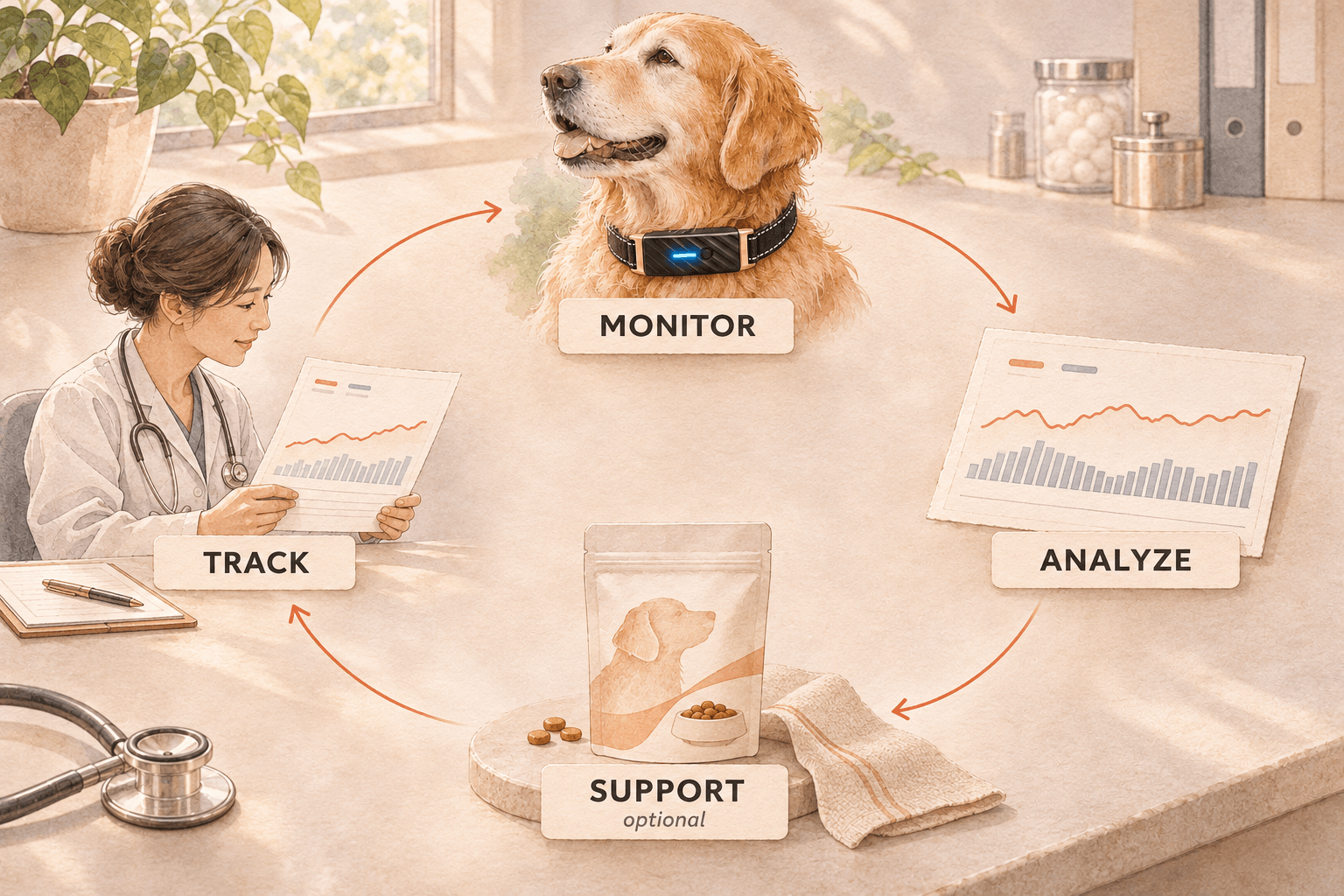
The feature that actually retains customers is not the cutest AI. It is the closed loop: monitor → analyze → support → track. A collar that flags a drift, then points to a nutrition or care follow-up, then shows whether that follow-up moved the numbers, gives the owner a reason to keep the device on. That is the difference between a one-time gadget sale and a recurring category.
A note on bundling: the collar and the nutrition line are separate products. A buyer can take the collar without the nutrition, and vice versa. The loop is the strategy — a reason to keep monitoring — not a forced purchase requirement.
What KIYE Ships Today vs. the Roadmap
To keep the tiering honest, here is where KIYE stands. The Gen1 KIYE Smart Collar (dog and cat) is built and shipping: GPS positioning plus automatic recognition of a dozen-plus daily behaviors — play, rest, eating, drinking, walking, sleeping, and more — with a factory-embedded eSIM so the buyer never installs a SIM. Vitals such as heart rate and temperature are not on Gen1; they are on the roadmap via the Collar Plus (PPG + infrared) and the KIYE Smart Mattress (PVDF sensor pad for rest-time vitals), both in development. The AI today delivers behavior baselines and anomaly flags a clinic can read — not a vital-sign monitor.
A 5-Point Checklist for Clinics and Distributors
- Does the AI produce a longitudinal baseline, or just momentary scores?
- Can the data leave the app — PDF, CSV, or API?
- Are flags explained in plain, non-diagnostic language?
- Is the senior / aging-pet use case explicitly supported?
- Is the data portable and the fee structure honest?
become a KIYE partner.