
For any team running senior pet care distribution across borders, the first question is usually the wrong one. Buyers ask which market is biggest. The real bottleneck for a closed-loop system of wearable monitoring and daily senior nutrition is not demand — it is the per-market cost of compliance and fulfillment. The UK, EU, and Japan all have aging-pet demand. They do not share a rulebook.

Demand looks alike. The setup does not.
Start with the part that is genuinely similar. Senior pets are a structural majority in the markets that matter to a distributor, not a passing niche. In the United States, 52% of dog-owning and 50% of cat-owning households had a pet aged 7 or older in 2025, a share that has held near 50% since 2019 (Packaged Facts, 2026 US Pet Market Outlook). Aging is the baseline, not the trend.
Europe shows the same gravity. The region holds 299 million pets across 139 million households, with a pet food market of EUR 29.3 billion growing 9% (FEDIAF Facts & Figures, 2025). The UK alone has 34 million pets and a GBP 9.1 billion pet food market (PFMA, 2025). These are mature, premiumizing markets where per-animal spend keeps climbing even as volumes flatten.
Japan is the clearest aging-pet case of the three. An estimated 35–40% of dogs and 25–30% of cats are over seven years old (IndexBox, 2026), against a dog population of 6.82 million and 8.85 million cats (Japan Pet Food Association, 2025). The total pet-related market reached about JPY 1.95 trillion, roughly USD 12.7 billion, in fiscal 2025, up 2.1% as spend-per-animal rose (Yano Research Institute, September 1, 2026).
The through-line is consistent: in each market the senior share is large enough to anchor a dedicated assortment, and growth comes from owners trading up per animal rather than from more pets. That is exactly the demand profile a closed-loop senior system is built for.
| Market | Pet market scale | Senior-pet signal | Lead channel |
|---|---|---|---|
| United States | USD 158B spent 2024, 165B forecast 2026 (APPA, 2025) | 52% dog / 50% cat households have a 7+ pet (Packaged Facts, 2026) | Vet + retail + e-commerce |
| European Union | EUR 29.3B pet food, +9% (FEDIAF, 2025) | 299M pets / 139M households | Specialty + grocery |
| United Kingdom | GBP 9.1B pet food (PFMA, 2025) | 34M pets / 17M+ households | Specialty + online |
| Japan | ~USD 12.7B, FY2025 (Yano, 2026) | 35–40% of dogs 7+ (IndexBox, 2026) | Specialty 35%, online fastest (Mordor, 2026) |
The divergence is regulatory, not cultural
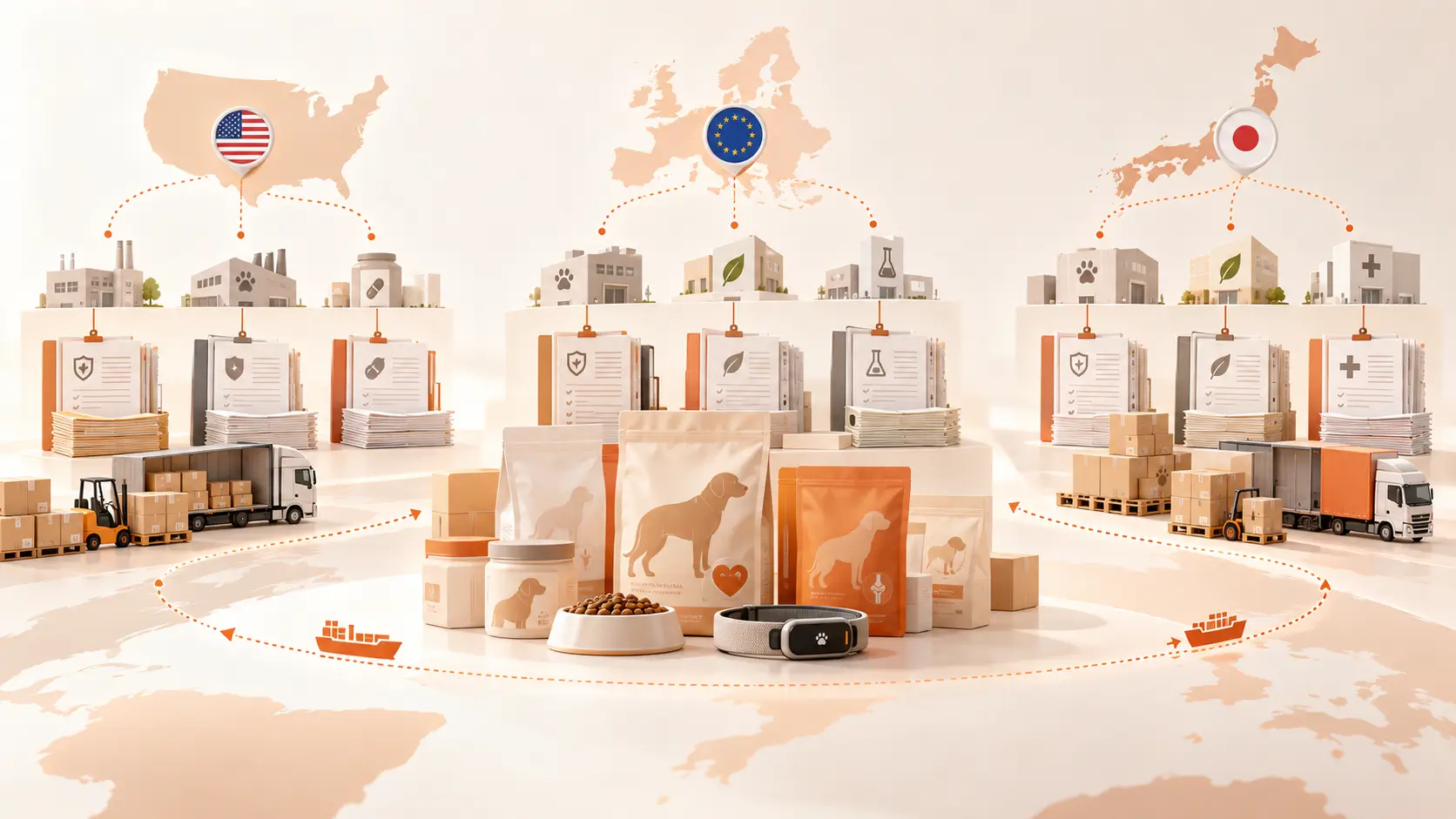
The three markets agree on the customer but not on the paperwork. The EU runs a harmonized framework across 27 jurisdictions, which sounds simple until one formula meets 27 language-labeling and national interpretation layers. The UK operates its own post-Brexit regime, so a dossier cleared in the EU still needs a separate UK path. Japan answers to the Ministry of Agriculture, Forestry and Fisheries under the Feed Safety Law, where a novel feed additive can take 12–24 months and USD 100,000–300,000 per ingredient to clear (IndexBox, 2026).
Recent tightening raises the bar further. Updated labeling requirements under Japan’s Pet Food Safety Act push credibility toward established suppliers with regulatory capacity (Mordor Intelligence, 2026). None of this is a reason to avoid a market. It is a reason to price the entry correctly: the setup tax, not the shelf space, is what decides whether a launch breaks even in year one. A senior pet products wholesale plan that ignores this math will overstate the addressable margin in every new market.
The integration dividend most buyers miss
Here is the claim worth debating. A distributor weighing senior-pet health usually models the category as a list of separate SKUs — a monitor from one vendor, a supplement line from another, a platform from a third. Each vendor is a separate compliance file, a separate import lane, and a separate replenishment clock. Multiply that across the UK, EU, and Japan and the setup tax compounds.
One closed-loop system beats a shelf of separate vendors
A pre-integrated offer — continuous wearable monitoring for dogs and cats, an AI platform that turns that data into structured health reports, and daily senior dog nutrition — collapses many supplier relationships into one. For a buyer entering Japan or the EU, fewer supplier touchpoints means fewer regulatory files and one replenishment plan, not three. That is a setup-cost advantage a single device or a single supplement jar cannot show on its own, and it is the part most pet health collar supplier pitches leave out because they only sell the hardware.

The collar itself is species-flexible: the Smart Health Collar fits both dogs and cats, so a distributor can carry one monitoring SKU across two species while the nutrition leg stays focused on senior dogs. That mix keeps the catalog tight in markets where every added SKU is another compliance line to clear. It is also why senior dog nutrition pairs naturally with the monitoring data instead of competing with it on the shelf.
A monitor vendor files one dossier, a nutrition vendor files another, and a software vendor answers to yet another import category. In Japan, where a single novel ingredient can cost six figures and up to two years to clear, those separate files are not a rounding error — they are the launch budget. Stacking three vendors in three markets is nine setup cycles before the first unit sells.
Sequence markets by setup cost, not size
The practical read for a buyer: do not rank markets by total spend alone. Rank them by how cheaply you can legally land and replenish product there. A market you can serve through FBA-ready packaging and existing logistics may beat a larger market that requires local warehousing and a fresh regulatory dossier. This is the part of senior pet care distribution that spreadsheets hide.
KIYE ships to 20+ markets with FBA-ready packaging, fast global logistics, and replenishment planning built into the partnership. For a distributor, that means the entry math for the UK, EU, and Japan starts from one supplier relationship rather than a committee of them. See how the partner model is structured before committing shelf space, and ask for market-by-market replenishment terms up front.
That is the real lesson for senior pet care distribution in 2026: the demand is already there in all three markets, and it is aging on schedule. The edge goes to the buyer who treats market entry as a compliance-and-fulfillment problem first and a merchandising problem second.
Map your senior-pet entry before you commit shelf
Every market rewards aging-pet demand differently at the compliance desk. Talk to us about sample specs, market-by-market replenishment, and which configuration fits your logistics first. Reach the team at info@kiyepet.com.
Sources
- Packaged Facts, 2026 US Pet Market Outlook
- FEDIAF Facts & Figures, 2025
- PFMA, 2025
- IndexBox, Japan Pet Care Ingredients Market, 2026
- Japan Pet Food Association, National Survey of Dog and Cat Ownership, 2025
- Yano Research Institute, Japan pet-related market FY2025, September 1, 2026
- Mordor Intelligence, Japan Pet Nutraceuticals Market, 2026
- APPA State of the Industry Report, 2025
`