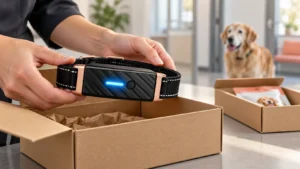
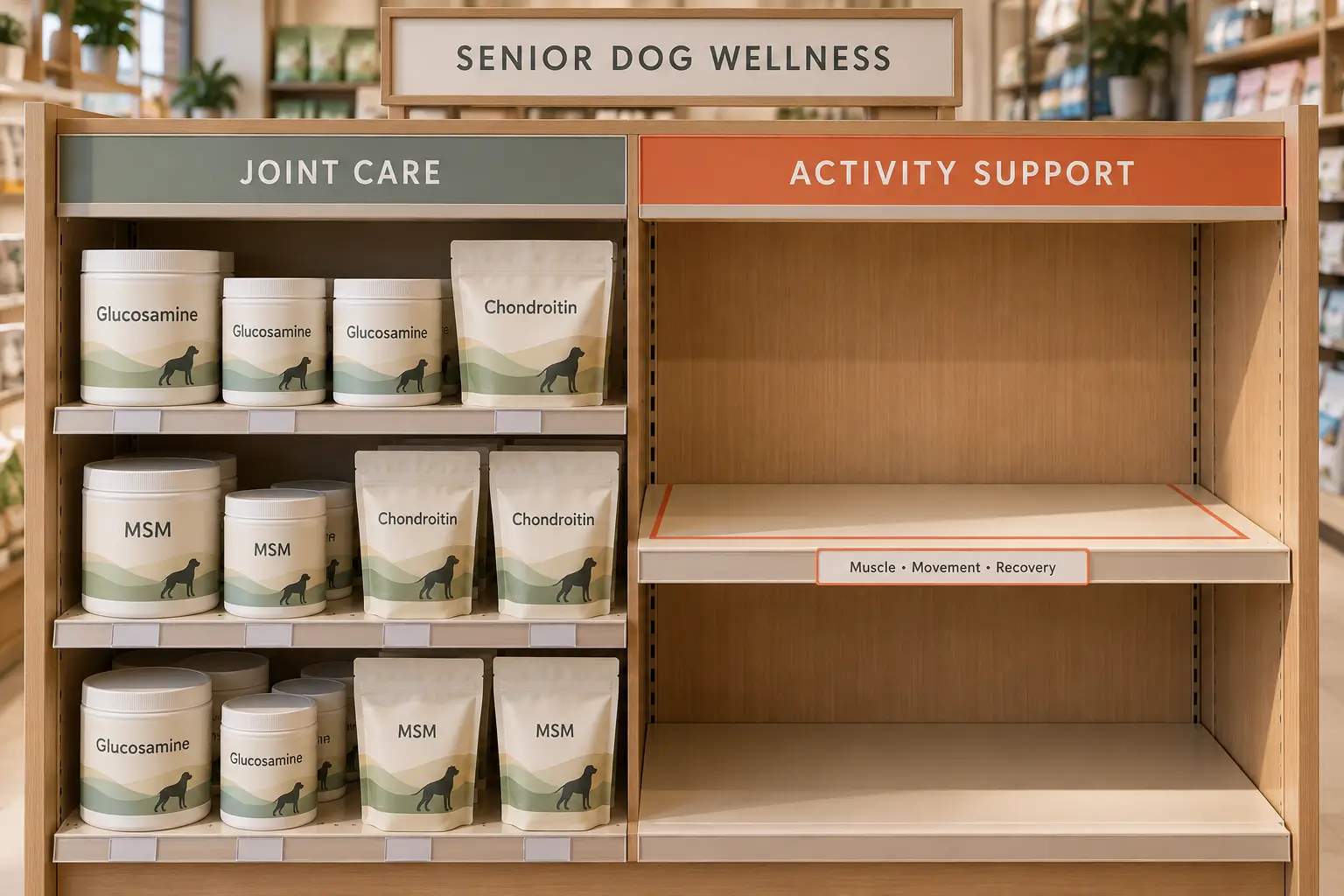
Most distributor shelves still sort senior dog products under one label: joint care. That framing is now too narrow. A senior dog’s decline shows up first as lost muscle, slower recovery, and lower daily activity, not just stiff joints. Distributors who treat “senior” as a joint-aisle problem are leaving an activity-maintenance aisle empty, and for buyers planning senior dog nutrition for next year, that empty slot is the opportunity.
The senior dog shelf was built for one problem
For years the senior dog category has been organized around mobility, and mobility meant joints. Walk the senior set in most senior pet products wholesale catalogs and you find glucosamine, chondroitin, and MSM stacked beside orthopedic beds. That made sense when the only visible sign of aging was a limp.
It no longer matches the dog. The senior base is large and stable: 52% of US dog-owning households had a dog aged 7 or older in 2025, a share that has held near 50% since 2019 (Packaged Facts, 2026 US Pet Market Outlook). Those dogs are not all limping. Many are quietly losing condition in ways a joint label cannot capture.
The buy side reinforces the narrow framing. Distributors plan senior dog sets the way suppliers cataloged them years ago: one joint bay, a few senior kibble listings, and a shared endcap with dental treats. The planogram has barely moved even though the dog in the aisle has.
Two signals the activity aisle is opening
For senior pet care distribution, the interesting part is not the chews themselves; it is what the launches say about where the senior dog shelf is going. This month two supplement makers launched canine weight-and-muscle soft chews in the same week, both built on a leucine-metabolite ingredient used in muscle-maintenance formulas (Petfood Industry, Oct 13-14, 2026). They are not pitching joints. They are pitching the dog’s body composition and daily energy.
The demand signal behind them is hard to ignore.
An overweight senior dog carries the joint story plus a second, separate problem: lost muscle and reduced activity. Stocking only joint relief leaves the muscle-and-weight half of the dog unaddressed.
Activity maintenance is a different stocking decision
The claim
Distributors should stop treating “senior dog” as a synonym for “joint.” The faster-growing need is maintaining activity: muscle, daily movement, and recovery. That requires a separate shelf position, not a line extension of the joint range. Buyers who file it under joints will under-buy it.
In senior pet care distribution, joint products are the known quantity: they sell on a single, well-understood promise — less stiffness. Activity-maintenance products sell on a harder promise: the dog keeps moving, keeps muscle, recovers faster. That promise is harder to stock because it is harder to prove on a label. A retailer can show a joint claim with an ingredient list. Showing that a dog is actually staying active takes measurement, not just formulation.
The part labels cannot show
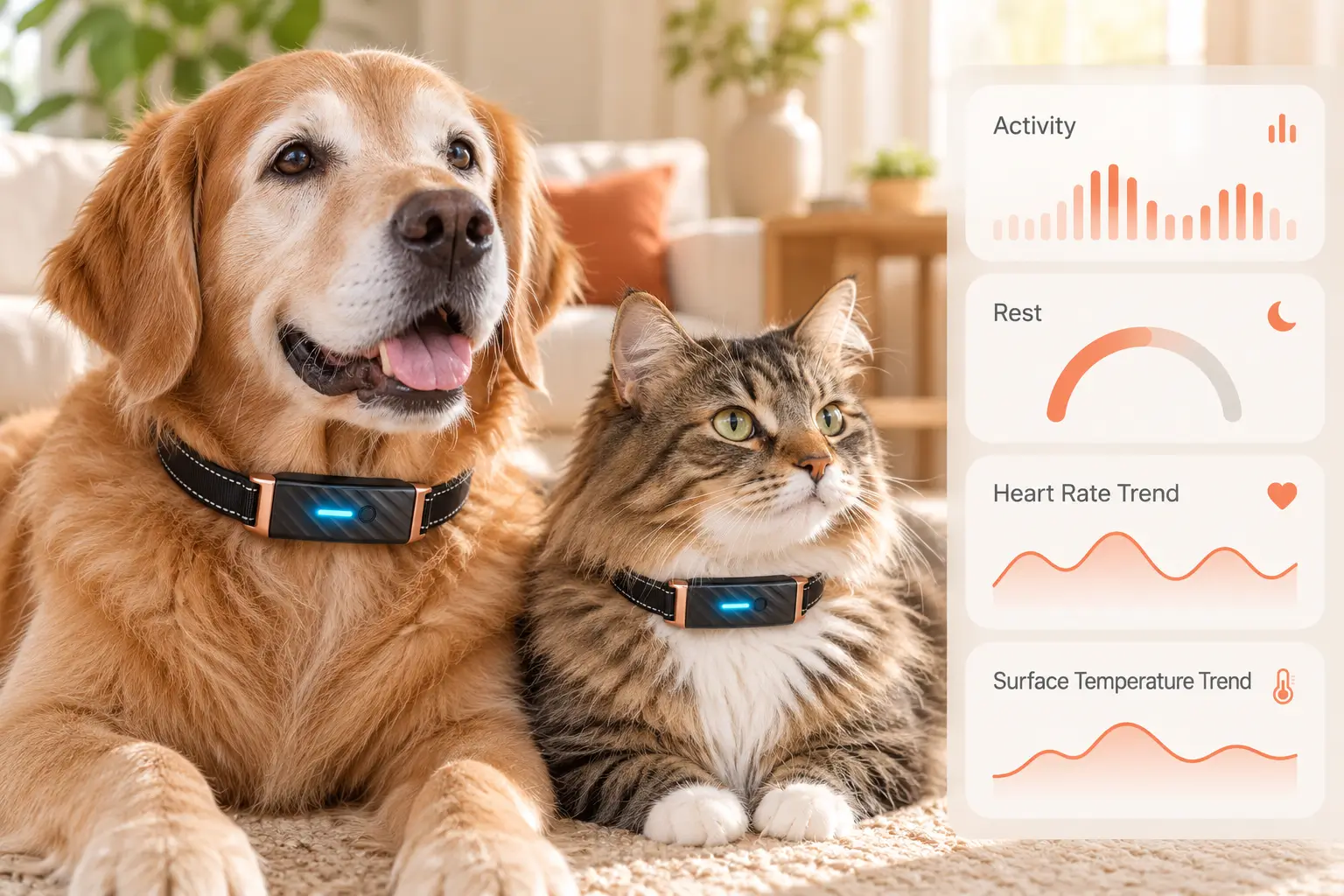
This is where continuous monitoring changes the category. A smart collar worn 24/7 collects activity and rest patterns that, read over weeks, surface changes in a senior dog’s daily movement. In a 703-dog study, collar-based resting heart rate readings reached 99.6% agreement with reference measurement, and respiratory rate 98.6% (Sidewalk Dog, 2026, reporting Frontiers in Veterinary Science).
A distributor stocking an activity-maintenance range can pair it with the one device that makes the promise measurable: a collar that monitors activity and rest continuously, for both dogs and cats. For a pet health collar supplier, this is the difference between selling a device and selling a measurable result. That pairing is what separates a label claim from a result a buyer can see.
For a retail buyer, the monitoring layer also solves a floor-level problem. Staff can describe a chew, but they cannot show what a chew changes. A collar makes the senior range demonstrable: the customer sees their own dog’s activity trend, and the retailer gets a concrete reason for that customer to come back to the same shelf.
What the activity-maintenance range should carry
The joint aisle and the activity aisle are not the same planogram. Here is the practical split a buyer should use. A closed-loop supplier, pairing a senior dog nutrition line with a monitoring collar, has a structural edge in the open column because the nutrition can be timed to the dog’s day.
| Position | Joint aisle (existing) | Activity aisle (open) |
|---|---|---|
| Core need | Mobility, stiffness relief | Muscle, daily movement, recovery |
| Typical SKU | Glucosamine, chondroitin, MSM | Leucine-metabolite, protein-support chews |
| Proof on shelf | Ingredient list | Continuous activity and rest data |
| Reorder driver | Chronic, steady | Daily routine, habit-formed |
| Companion device | Orthopedic bed | 24/7 health collar |
Close the loop, don’t just fill a slot
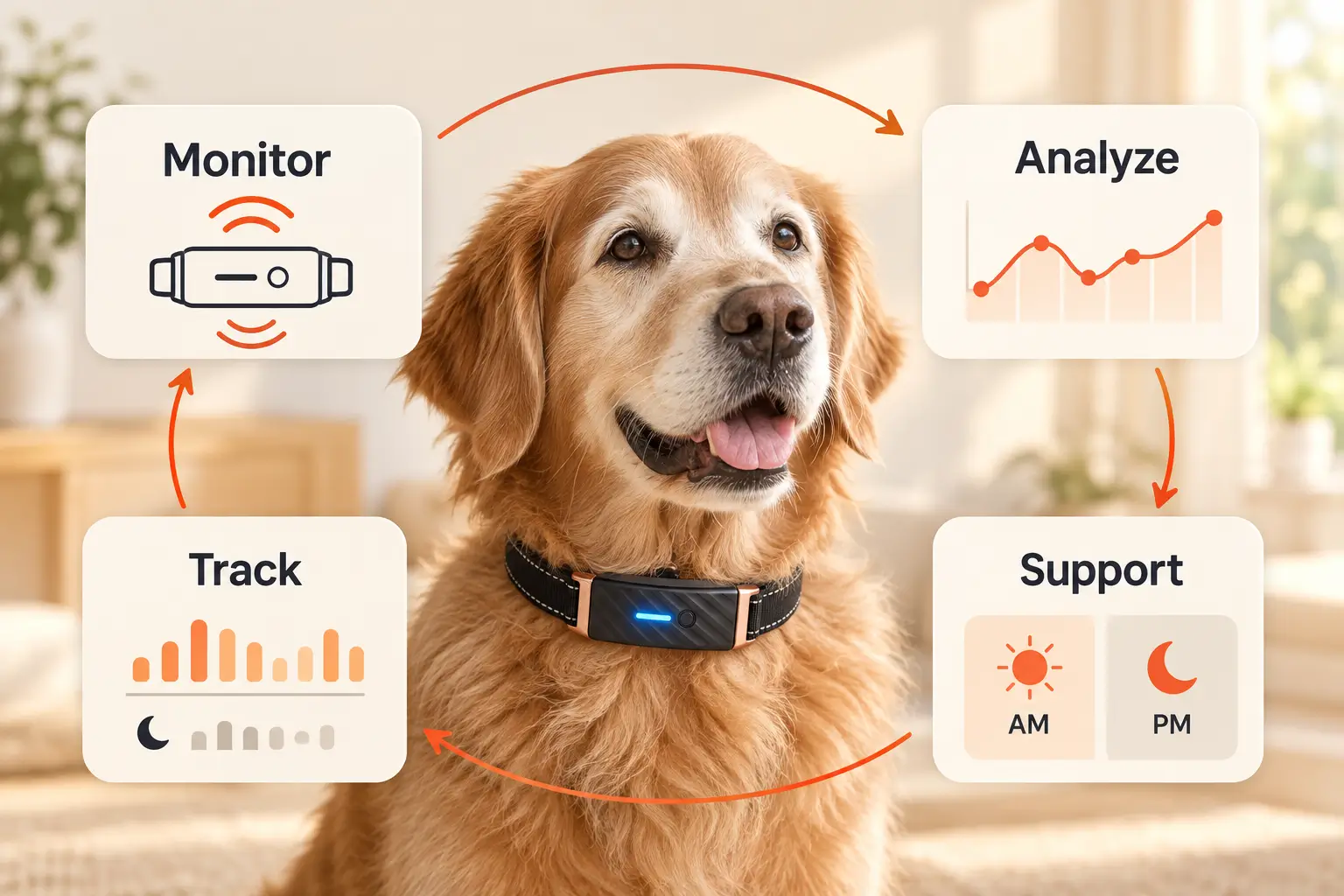
KIYE’s senior dog nutrition is built as AM and PM support around the older dog’s daily rhythm, not a single daily dose. Paired with a collar that monitors activity and rest, the range becomes a system: monitor the dog, read the trend, support the day, track continuously, and keep the dog healthier for longer.
That five-step loop is what lets a distributor sell “activity maintenance” as a measurable category rather than a hopeful one. In senior pet care distribution, the activity aisle is the uncrowded side of the senior pet health ecosystem.
There is also a cadence argument for the distributor. Products keyed to a daily routine are easier to restock than products keyed to a memory. The collar keeps the routine visible; the AM and PM format gives the routine a refill date.
Sources
- Packaged Facts, 2026 US Pet Market Outlook (52% of dog-owning households have a 7+ year dog; share near 50% since 2019)
- Petfood Industry, Oct 13-14, 2026 (two supplement makers launch canine weight-and-muscle soft chews built on a leucine-metabolite ingredient)
- Petfood Industry, Oct 14, 2026, citing FDA feeding data (59% of US dogs overweight)
- Sidewalk Dog, 2026, reporting Frontiers in Veterinary Science (703-dog collar validation: 99.6% resting HR accuracy, 98.6% respiratory rate)
The activity aisle is the open side of the senior dog set
KIYE pairs a 24/7 health collar with AM and PM senior dog nutrition so distributors can stock activity maintenance as a measurable range, not a label claim. Review the product specs, request samples, or discuss channel fit with our team at info@kiyepet.com.