
The value of a senior pet health collar is moving from the device to the data it produces. For a distributor, the question is no longer only whether the collar tracks well, but who controls the smart collar data after it is collected. A collar whose data is locked to one app or one insurance partner is a different kind of risk than one whose data the owner and the clinic can actually use.
The buyer’s customer has changed. A distributor does not sell only to pet owners; veterinary practices and insurers are now part of the conversation, and both want continuous health signals. The product that earns shelf space is the one whose data can leave the app and enter the systems that interpret it, not the one that keeps the signal inside its own dashboard.
The data, not the device, is what the channel wants
The pet wearable market is growing from about $3.56 billion in 2026 to an estimated $7.23 billion by 2031, with smart collars holding roughly 64% of revenue (Sidewalk Dog, 2026). That growth is not driven by the plastic. It is driven by what the device produces: continuous wellness trends a clinic or insurer can act on. A collar that only shows a number on a phone is competing for attention it will lose to one that feeds a workflow.
The same pull shows up in insurance. The U.S. pet insurance market reached $4.8 billion in premiums in 2025 and is still expanding (NAPHIA, 2025). Insurers are looking for continuous health signals to price and manage risk, which is exactly the stream a health collar produces. That is why some collar programs now tie the device to a specific subscription or partner: the data is the asset, and the lock-in is the business model.

The lock-in assumption distributors should question
The industry default has been that the app which collects the data owns it. That assumption is now being tested by commercial bundles where the device only works fully inside one ecosystem. A distributor who stocks that collar inherits the lock-in: the owner cannot export a report, the clinic cannot ingest the trend, and the reorder depends on a relationship the distributor does not control.
This is an assumption worth challenging, not a fact of the category. A health collar can be built so the wellness data is portable by design, owned by the pet owner, and readable by any clinic. The question for a buyer is which model the SKU actually ships with, because the two models carry completely different downstream risk for the channel.
A locked-data collar is a liability on your shelf, not a feature
A distributor who stocks a device whose data cannot leave the app is stocking someone else’s subscription funnel. The collar that protects the channel is the one whose output the owner and the clinic can use without asking permission, because the relationship then stays with the products that actually help.
What data portability means for a buyer
The practical test is export. Can the collar’s wellness trends leave the app and enter a clinic’s system, or do they die inside a consumer dashboard? Can the owner download a structured health report, or is the data hostage to a login? Only the first version belongs on a distributor’s shelf in 2026, because the clinic, not the owner’s phone, is where the recommendation now gets made.
| Test | Locked ecosystem | Portable by design |
|---|---|---|
| Report access | Stays inside one app | Owner downloads a structured report |
| Clinic use | Not ingestible | Clinic-ready export |
| Subscription | Mandatory to read data | No fee to own the data |
| Reorder control | Tied to one vendor | Open and owner-led |
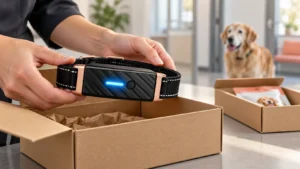
The KIYE Smart Health Collar is built for the portable model. It captures four core health dimensions around the clock and works for both dogs and cats, then hands the stream to an AI platform that turns it into a readable health report the owner and the clinic can both use. Because the data is owner-controlled, the collar is a point of entry to the KIYE health ecosystem, not a wall around it.

Why portability protects the distributor’s margin
A portable collar protects the channel in two ways. First, it removes the subscription dependency that makes a SKU fragile: the owner is not paying a third party to read their own pet’s data, so the relationship stays with the products that actually help. Second, portable data feeds the repurchase loop. The KIYE Senior Pet Nutrition line is timed to the daily changes a collar surfaces, with AM and PM formats built around the animal’s needs. The insight a collar produces turns into a product the owner buys and rebuys, and that loop lives in the distributor’s catalog, not inside a closed app.
This is why KIYE positions itself as a system supplier rather than a single-SKU brand. The margin and the reorder sit in the loop, not in one device, and the loop only works if the data is open. A buyer evaluating a pet health collar supplier should weigh one capability above the rest: does the device give the owner and the clinic control of the data, or hold it?

The stocking gate for 2026
Stock the system, not the gadget. For any team planning senior pet care distribution, the takeaway is to treat data policy as a stocking gate alongside price and warranty. A collar that locks data may sell once; a collar that frees it sells into a loop the distributor owns. The teams building a senior pet products wholesale plan around a portable, owner-controlled collar, paired with the senior dog nutrition line that closes the loop, will be the ones the clinic and the owner both come back to.
The window is already open. Wearable growth, insurance demand, and clinic AI adoption are converging on the same asset: continuous pet health data. The distributors who ask who owns it before they stock it will be the ones who benefit from the answer, because the control of the data is becoming the control of the category.
Sources
- Sidewalk Dog, pet wearable market sizing and AI-collar accuracy data, 2026.
- NAPHIA, U.S. pet insurance premium volume, 2025 State of the Industry report.
- Packaged Facts, 2026 U.S. Pet Market Outlook (senior pet household share).
The data policy is now part of the spec
Distributors stocking a health collar in 2026 should weigh one capability above the rest: does the device give the owner and the clinic control of the data, or hold it? Review the KIYE system specs, request samples, and discuss channel fit with our team at info@kiyepet.com.



One Response