
As a Golden Retriever owner, you are familiar with their boundless energy, the constant tail wags, and their fierce loyalty. But because Goldens are notoriously people-pleasers, they possess a heartbreaking trait: they hide their pain to keep you happy.
Most owners think their Golden Retriever is just "slowing down" because of old age. In reality, aging isn’t a sudden drop—it’s a series of micro-behavioral shifts that happen in the dark. By the time your dog starts limping or whimpering, the underlying condition has often progressed for months.

This comprehensive guide will break down the silent Golden Retriever aging signs and behavioral changes you must watch for to protect your dog’s healthspan.
1. Golden Retriever Joint Pain Symptoms: The Micro-Shifts in Mobility
When searching for signs of Golden Retriever joint pain, most owners look for an obvious limp. However, canine joint degeneration (like hip dysplasia or arthritis) shows up much earlier in their daily routines.
What to Watch For:
The "Hitch" Before the Leap: A split-second hesitation before jumping into the car or onto the couch.
The Guarded Posture: Standing with their hind legs tucked slightly forward to shift their body weight onto their front legs.
Subtle Sleep Restlessness: Changing sleeping positions 5–10 times a night, trying to find an angle that doesn’t put pressure on aching joints.
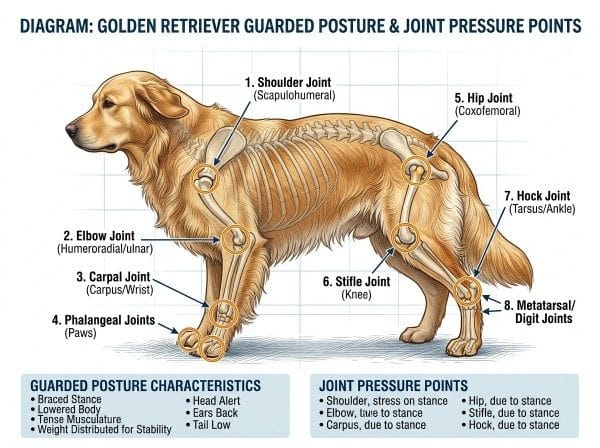
The Reality Check: You see your dog eventually make the jump and think they are fine. What you don’t see is the 15% increase in micro-awakenings throughout the night caused by joint throbbing.
2. Canine Cognitive Dysfunction (CCD): Why Is My Old Dog Restless at Night?
One of the most distressing Golden Retriever behavioral changes in senior years is the disruption of their sleep-wake cycle, often linked to Canine Cognitive Dysfunction (dog dementia).
What to Watch For:
The Midnight Pace: If you find yourself asking, "Why is my old dog restless at night?", pay attention to when it happens. Midnight pacing or staring at walls is a classic early indicator of sundowning syndrome.
Delayed Response to Commands: It’s not that they are suddenly stubborn; their cognitive processing speed is slowing down.
Changes in Affection Levels: Becoming unusually clingy, or conversely, isolating themselves in rooms they used to avoid.

3. Subtle Metabolic and Respiratory Signals
Large breeds like Golden Retrievers are prone to metabolic shifts and cardiac issues as they age. These don’t always manifest as a dramatic cough or collapse.
What to Watch For:
Resting Respiratory Rate (RRR) Spikes: An aging dog’s heart and lungs have to work harder. A sustained increase in breaths per minute while deeply asleep is an invisible red flag.
Unexplained Excessive Scratching: Often misdiagnosed as allergies, sudden restlessness and scratching in senior Goldens can indicate chronic systemic inflammation or localized discomfort.
4. The Blind Spot of Human Observation
As humans, we estimate health based on snapshots. We see our Golden grab a tennis ball for 5 minutes, and we tell ourselves, "He’s still got it."
But you cannot manage what you do not measure. Human eyes are biologically incapable of tracking a 12% decrease in deep sleep over three weeks, or a subtle 40-minute increase in nighttime pacing. Our love makes us optimistic, but optimism is not a health strategy.
5. Turn Invisible Signals into Actionable Data with KIYE
You don’t have to guess if your Golden Retriever is in pain. You don’t have to wonder if they are sleeping soundly.
The KIYE Smart Collar acts as a 24/7 health radar for your dog. While traditional GPS trackers only tell you where your dog is, KIYE monitors the invisible metrics that define their healthspan: Resting Respiratory Rate, sleep quality scores, scratching frequencies, and micro-mobility degradation.
Our AI Health Interpretation Engine doesn’t just dump raw data onto your screen. It translates biometric shifts into immediate, actionable health protocols:
"Over the past 14 days, Milo’s deep sleep has dropped by 17%, and his nighttime restlessness has increased by 42%. Based on our global Golden Retriever database, this biometric pattern correlates heavily with early-stage joint discomfort."
When KIYE detects these anomalies, it immediately unlocks your tailored Golden Retriever Mobility Protocol—delivering clinical-grade, targeted joint support and lifestyle adjustments directly to your door before the limp even begins.
Your dog can’t tell you what hurts. But KIYE can. Don’t wait for the symptoms to become obvious. Maximize your Golden’s healthspan today.