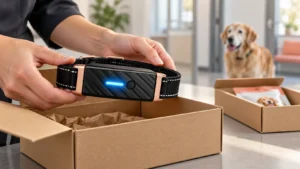
When a distributor first looks at a smart pet collar, the conversation usually starts with specs — battery life, water resistance, GPS accuracy, the number of health metrics. Those matter. But there is a second question that shapes whether the product actually sells through, reorders, and stays on the shelf: what business model is attached to the collar? For an increasing share of connected pet wearables, the answer is a recurring monthly fee. This article walks B2B buyers through what that fee typically covers, why it changes the distributor’s role, and the questions worth asking before you stock a subscription-based line.
What "subscription" usually covers
A smart collar is rarely just hardware. Most connected models pair the device with a companion app and a cloud service that stores history, computes trends, and in some cases layers AI-assisted health scoring or remote-vet access on top. The recurring fee is how the brand funds that backend.
In practice the subscription may bundle one or more of:
- Cloud storage and history — keeping months of heart rate, activity, and rest data accessible.
- Advanced analytics — trend lines, age or breed baselines, anomaly alerts beyond raw numbers.
- Connectivity — some trackers include a cellular plan for GPS without a paired phone.
- Telehealth or vet chat — a channel to a veterinary professional.
- Warranty or replacement — occasionally folded into the monthly plan.
None of this is inherently good or bad. It reflects a real cost of running a connected service. The point for a distributor is simply to know which of these the buyer is paying for, and which the distributor is implicitly promising.
Why a monthly fee changes the distributor’s job
A one-time product sale ends at the register. A subscription product begins a relationship that has to be serviced every month — billing questions, app login issues, cancelled renewals, and the occasional "why did my alert stop."
Two structural consequences follow:
1. The renewal may not belong to you. If the brand handles billing and owns the customer account, the distributor’s contact with the end buyer can thin out after the first sale. That is workable, but it means the distributor is effectively a lead source for the brand’s recurring revenue — not the owner of it.
2. Churn becomes a category risk. When a subscription lapses, the collar often loses its "smart" features. A disappointed owner may blame the category, not the billing model. That sentiment can spill onto every collar you stock.
This is not a reason to avoid subscription products. It is a reason to understand, before you buy, where the recurring relationship lives and who is responsible for it.
Data ownership is the quieter issue
Specifications tell you what a collar measures. They rarely tell you who can read, export, or delete that data. In a subscription model, the pet’s continuous health record usually lives in the brand’s cloud.
For a distributor, that raises a practical question: if the data stays with the brand, the end customer is anchored to that brand’s ecosystem even after the hardware is paid off. The distributor’s buyer is, in effect, renting access to their own pet’s history.
A distributor-friendly model keeps the owner in control — exportable history, no lock-in to a single cloud, and clear terms on what happens to data if the plan ends. Stating this plainly in your listing helps the right buyers self-select.
KIYE Smart Health Collars surface wellness trends from continuous data; they are not a medical device and do not replace veterinary diagnosis.
Subscription is not automatically the wrong call
To be fair to the model: for some buyers, a bundled fee is genuinely convenient. It can fold support, connectivity, and advanced insights into one predictable line item, and it can lower the upfront price of the device. Veterinary-channel and subscription-ready ranges have their place (we have written separately about whether a supplement range is ready for subscription).
The claim here is narrower and evidence-bounded: distributors should know what they are stocking. A recurring fee is a feature with trade-offs, not a red flag by itself. The risk appears when those trade-offs are invisible at the point of sale.
What a low-lock-in model looks like
One approach — the one we build toward at KIYE — is to separate the hardware from the ongoing relationship:
- No mandatory monthly fee. Core monitoring works without a recurring charge.
- Owner-held data. The pet’s wellness trends are the owner’s to view and export.
- Third-party quality you can verify. Batch-level testing and traceable certificates, so the distributor is not the only one vouching for the product.
- A closed loop to nutrition. Collar trends can inform a senior-dog nutrition plan, closing the "did it actually help?" gap that pure supplements leave open — the case we make in what a closed-loop senior pet health system should include.
We present this as one coherent option, not the only path. Different distributors serve different buyers, and some will prefer a full-service subscription. The useful move is to map each brand’s model to the buyers you actually have.
Questions to ask a collar supplier before you stock
A short due-diligence list for the buyer’s desk:
- Is there a mandatory monthly fee, or is it optional?
- If optional, what exactly does the free tier lose?
- Who bills the end customer — the brand, or the distributor?
- Can the owner export their pet’s data? In what format?
- What happens to stored history if the plan lapses?
- Is connectivity (cellular GPS) included or billed separately?
- What are the batch-testing and certification practices per shipment?
These are not adversarial questions. They are the difference between stocking a product and stocking a relationship you understand.
Bottom line
Specs decide whether a collar is good. The business model decides whether it sells through and comes back. Before adding a connected line, separate the hardware from the recurring charge, confirm who owns the data and the renewal, and pick the model that fits the buyers you already serve. A transparent, low-lock-in approach (the logic behind why we lead with smart collars before senior dog nutrition) tends to build the reorder habit that keeps a senior-pet category healthy — and that is what most distributors are actually buying.
CTA: Talk to our distribution team about the KIYE partner pack — no monthly fee, owner-held data, batch-tested quality, and a collar-to-nutrition loop your buyers can see working. [Request the distributor kit →]