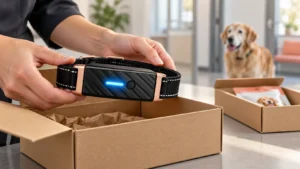
Beyond the Annual Exam: Why Vet Clinics Need Continuous Pet Health DataVeterinary clinics have always worked from snapshots. A dog or cat comes in once or twice a year, the clinician reads what the exam and that day’s vitals show, and the rest of the year is a blank. For senior pets — and a substantial share of households in the major markets now have one — that blank is exactly where the slow, expensive, hard-to-reverse problems develop. Distributors sitting across the table from clinic buyers are hearing the question framed a new way: not "does the device track location," but "does it give my practice a continuous read on the animals I’m responsible for between visits?" This piece looks at why continuous pet health data is moving from a nice-to-have to a clinic-channel expectation, and what that shift means for the ranges you stock.
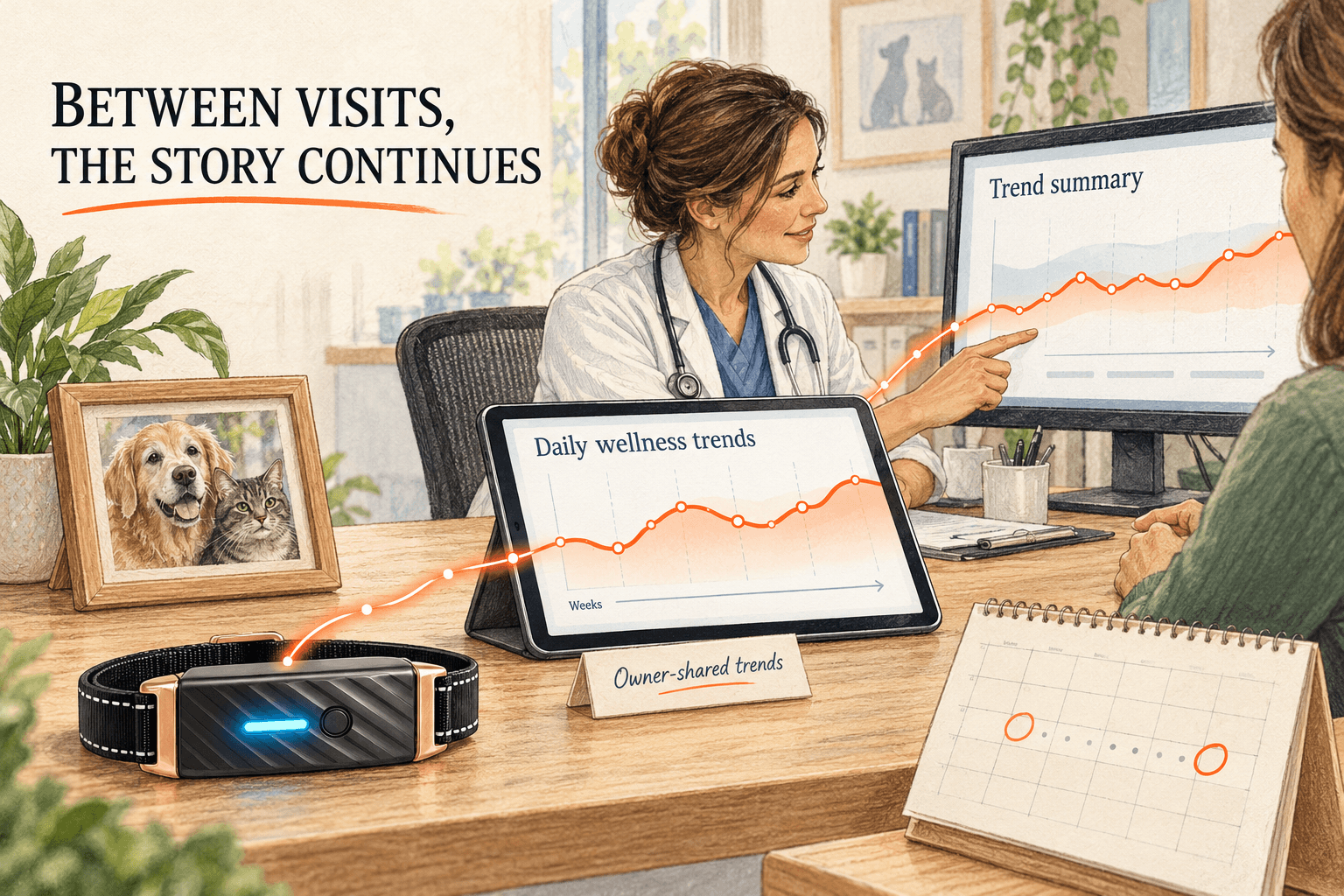
The signal that reaches the clinic is not a single reading — it is a trend built between visits.
The annual-visit gap is wider than the exam suggests
Care is episodic, and the intervals between appointments are where early changes in resting heart rate, activity, or rest patterns go unrecorded. In one US consumer study, 17% of dog and 29% of cat owners had missed a yearly check-up; in the UK, roughly a quarter of owners said they had declined treatment at some point because of cost. The percentages matter less than the pattern: a single clinic reading is a point on a line, not the line itself.
Sizing the opportunity starts with the animals themselves. In the US, roughly half of dog-owning households and half of cat-owning households include a pet aged seven or older — the segment where subtle daily changes matter most and where owners are most motivated to act on them. Senior pets are not a niche within a clinic’s book of business; they are close to half of it, and they visit more often, cost more per visit, and generate the longest treatment relationships.
For a distributor, that gap is the opening. Clinics are actively looking for tools that extend their reach beyond the appointment — without turning the practice into a 24/7 monitoring operation. A connected product that surfaces daily wellness trends gives the practice a reason to stay in the owner’s life for the other 363 days of the year, and gives the owner a reason to keep coming back.
What "continuous" actually changes for the clinic
A connected collar that surfaces daily wellness trends — resting heart rate, surface temperature, activity, and location — does one thing a scale or a once-a-year blood panel cannot: it builds a baseline that belongs to that individual animal. The useful output is not an alarm for every wobble. It is a readable trend the owner and the clinic can compare against, so a genuine change stands out from ordinary day-to-day noise.
This is where framing matters. The product should be described as wellness trends, not a medical device. That wording is deliberate: it keeps the collar in the consumer-wellness category, avoids medical-device regulation in most markets, and sets honest expectations with buyers and pet parents alike. A supplier that overclaims diagnostic ability creates return risk and liability you do not want on your shelf.
A line worth holding: continuous data supports observation. It does not replace the clinician, it does not diagnose a condition, and it does not validate that a supplement "works." The collar’s job is to surface signals worth a conversation — not to close the case.
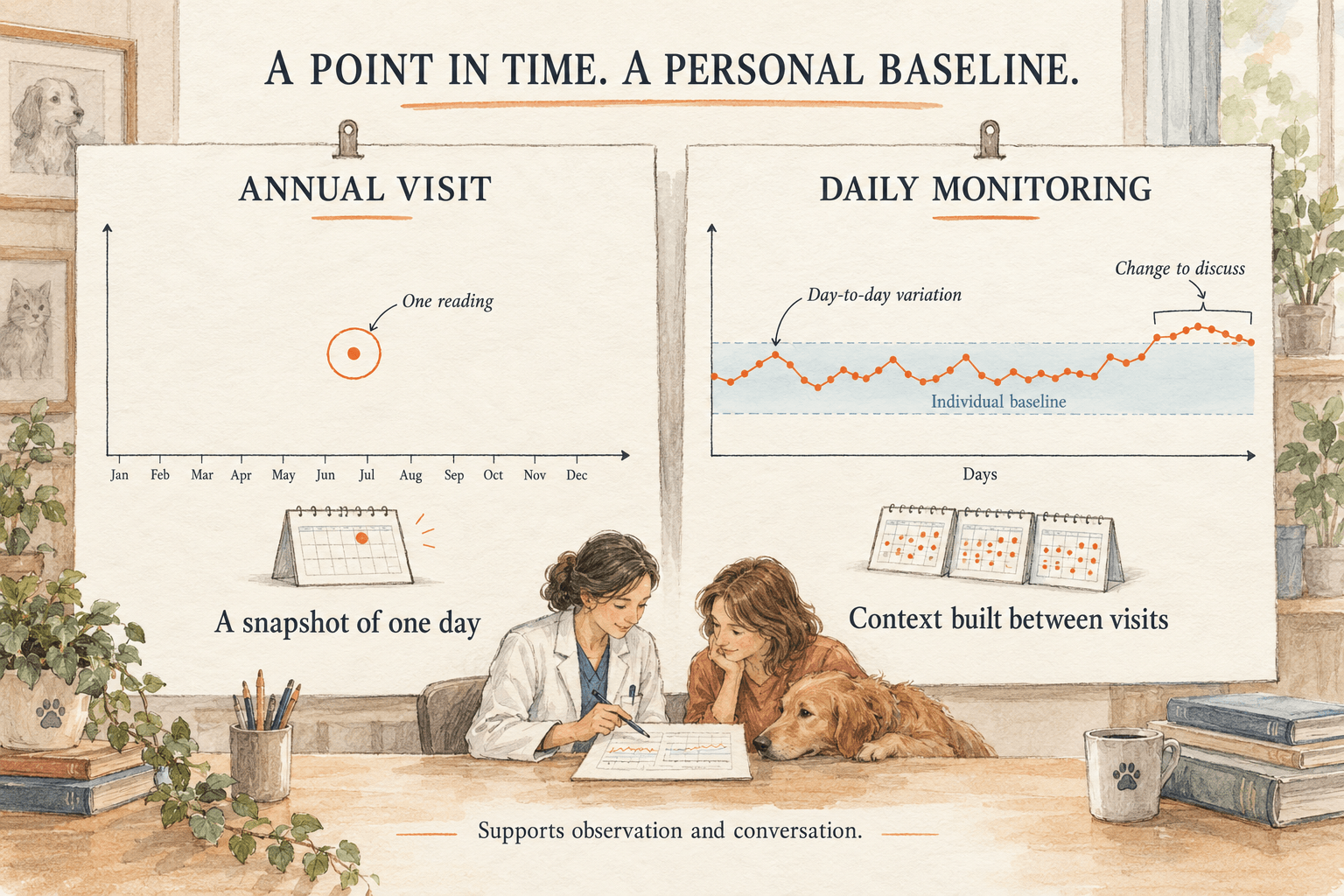
One clinic reading is a point; a continuous trend is the line clinicians can actually use.
Why this is a distribution opportunity, not just a gadget sale
The clinic channel behaves differently from mass retail. Attachment rate depends on whether the product earns a place in the practice’s workflow, not just a place on the shelf. A monitoring product that can hand the clinic a pet parent’s trend summary — with consent — becomes a reason for the owner to return to that practice, and for the practice to keep the product in front of clients. That repeat engagement is what turns a one-time placement into standing orders.
And there is the loop that single-product brands struggle to offer. When collar trends can inform a complementary senior dog nutrition line — daily feeding adjustments based on what the data shows — the data leads somewhere actionable instead of stopping at an alert. For a distributor, that loop is a category you can build shelf and clinic space around, rather than a single SKU competing on specs.
The species boundary here is worth stating plainly: monitoring covers both dogs and cats, because the collar is a wellness tool for either. The nutrition line referenced in the loop is for senior dogs only — that is the range it was built for, and the claim should never drift toward cats.
The practical test a clinic buyer will apply is simple: can your team train their staff on it in one visit, and does the trend summary give them something concrete to discuss with the owner in the room? Products that fail that test get trialed once and quietly returned. Products that pass it earn counter space — and word-of-mouth inside the practice, which is worth more than any end-cap.
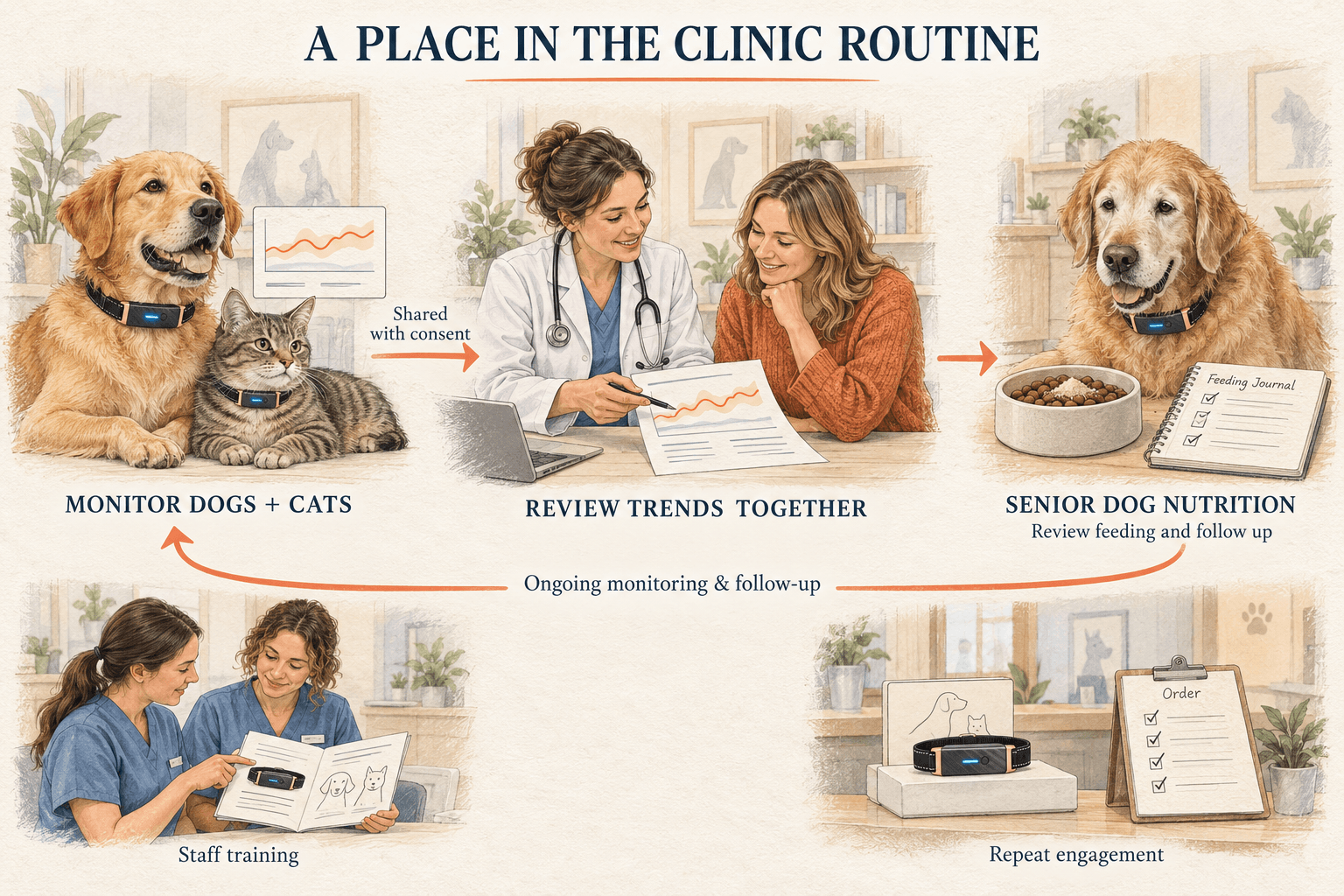
Data that leads somewhere actionable — collar trends inform nutrition adjustments, a loop single-product brands cannot match.
What to look for when stocking a clinic-ready collar
- Data export and ownership. The pet parent owns the data. The product gives a clean export and consent-based sharing with the clinic. Closed, subscription-tied silos suppress reorders and make the product feel like rental rather than ownership.
- A vet-friendly summary. What the practice needs is a simple trend view it can read in seconds, not a raw sensor dump. If the clinic cannot explain it to an owner in the room, attachment rate stalls.
- Honest framing. "Wellness trends, not a medical device." Overclaiming creates return risk and liability on your shelf.
- Certifications for regulated markets. CE, FCC, and RoHS as a baseline, plus batch-level traceability and third-party testing on materials and electronics — the minimum expectation for EU, UK, North America, Australia, and Japan clinic buyers.
- Channel support. Product training, shelf and digital assets, a reachable contact for technical issues, and a defined warranty and replacement flow. In a category where a single bad unit travels fast on social media, after-sales reliability protects your reputation as much as the clinic’s.
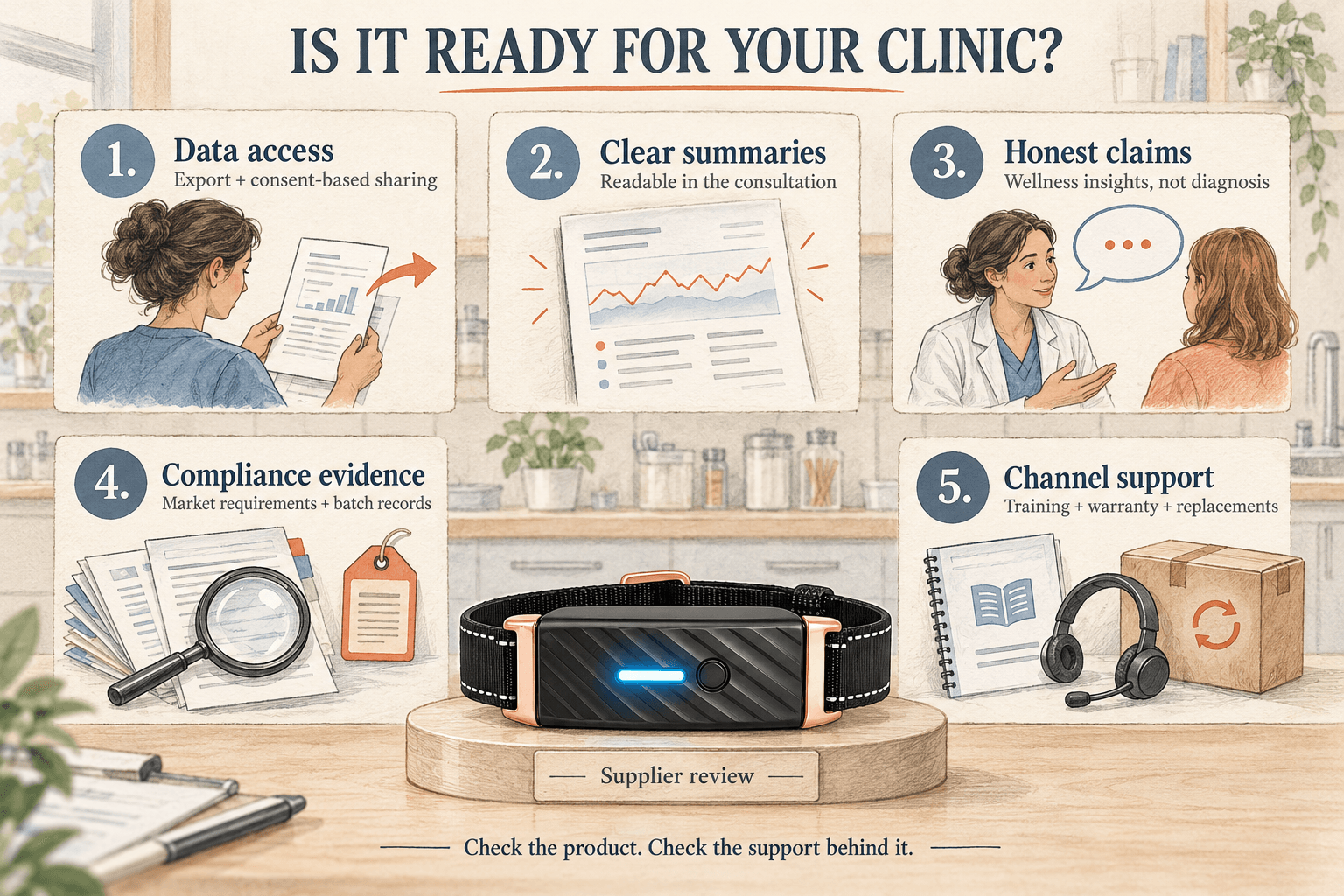
A clinic-ready range is more than hardware — shelf assets, training, and after-sales are what keep the product in the practice.
The takeaway for distributors
Veterinary clinics are not asking for more gadgets. They are asking for a way to keep caring for the animal after the owner walks out the door — and for a product that strengthens the practice’s relationship with the client rather than competing with it. Distributors who screen on that basis — defensible monitoring, clean data ownership, honest framing, certifiable quality, and real channel support — are the ones clinics will reorder from.
KIYE builds Senior Pet Health Solutions on exactly this model: a smart health collar for dogs and cats that surfaces daily wellness trends (heart rate, surface temperature, activity, GPS), paired with a senior dog nutrition line so the data leads somewhere actionable. We work with distributors, veterinary clinics, and selected retail channels across North America, Europe, the UK, Australia, Canada, and Japan.
If you are building or expanding a clinic channel, request our distributor pack: specifications, certification files, wholesale terms, and shelf-ready assets.